
During Impact Month, held on 21 November 2025 on the Rennes campus, researchers, digital artists, game designers and real-time experts debated the role of immersion in contemporary creation.
After Marc Petit’s monumental experiments (Episode 1) and Florent Laroche’s heritage dimension (Episode 2), this latest episode explores the balance between emotion, historical accuracy and interaction with the public through the eyes of Maxime Neveu.
And finally, a conclusion that sheds light on the way in which cultural immersion redefines the way in which culture is transmitted.
Maxime Neveu – Bringing history to life, without simplifying it
Somewhere between the monumentality of Marc Petit and the archival rigour of Florent Laroche, Maxime Neveu embodies the interface with the public. As a 3D creator, interactive designer and game designer, he develops immersive experiences for local authorities, museums, urban spaces and artistic events. Where some people think technology, he thinks use. Where we talk about tools, he talks about reception.
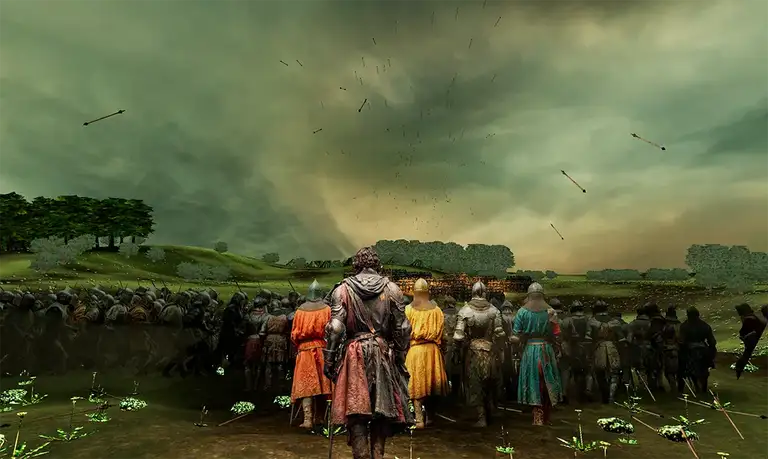
His project for La Garnache, in the Vendée, is a case in point:
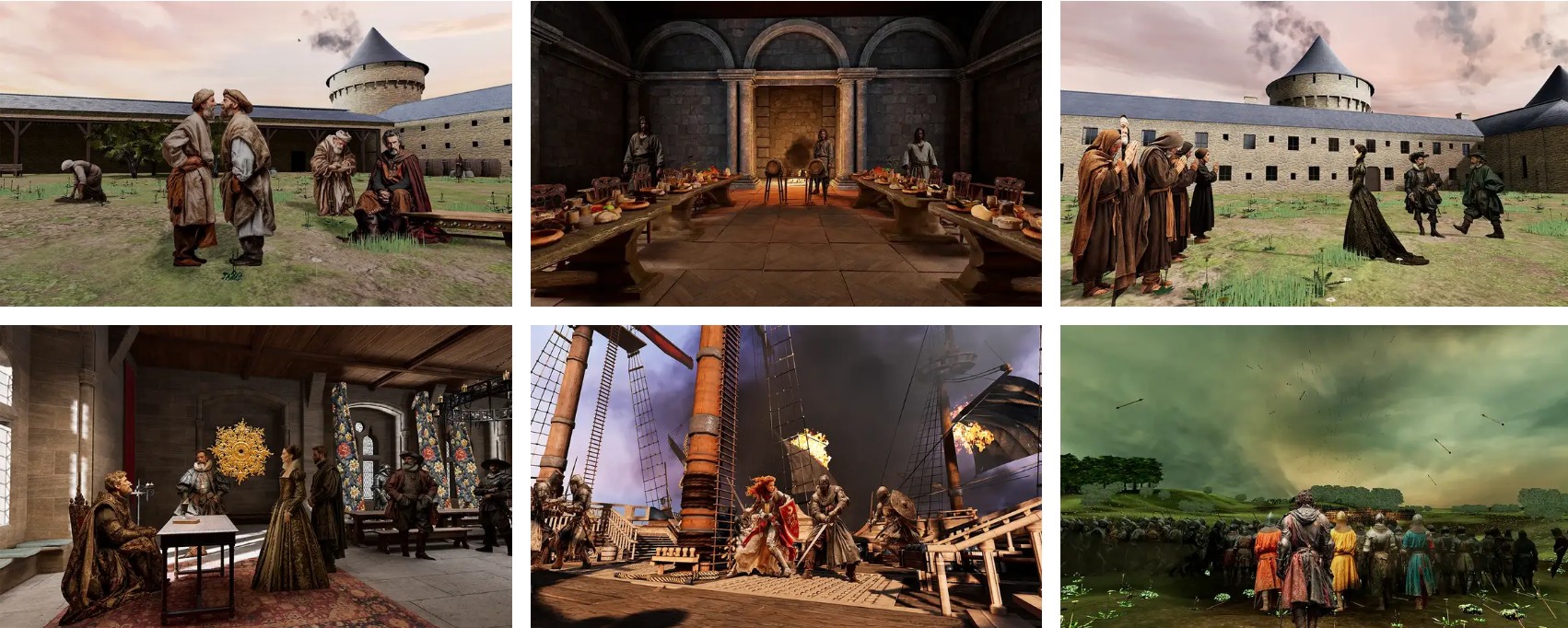
Five immersive films, a thousand years of history, reconstructed archives, researched clothing and textures, and a constant dialogue with historians. Every visual detail is argued. Nothing is gratuitously stylised.
“Historicity conditions the image.
This is not an arbitrary aesthetic. It’s a language of truth.
Then comes the central question of game design. Does immersion have to be interactive? Should the audience act, choose, influence?
For La Garnache, “the best solution was a linear, contemplative experience”.
Not gamifying is sometimes a choice of balance, not a reduction.
In contrast, his Lorient mapping is a space for artistic interpretation. No strict reconstruction. No neutrality. Archival images, electronic music, dynamic projections on facades: the city becomes a screen, a surface of memory, a place of imagination. Heritage is no longer simply preserved: it is put back into circulation.
Maxime Neveu works in a meeting place. Too much spectacularity kills the reading. Too much rigour makes the work inaccessible. Immersive creation aims for that in-between place where the story can be understood, felt and passed on.
Conclusion
A generation that doesn’t reproduce culture: it reformulates it
What these three speakers are showing, each in their own way, is that a new cultural landscape is taking shape. Immersion is no longer about displaying content to a passive audience, but about creating spaces that can be experienced, interpreted and travelled through. It uses 3D as a common language, whether it’s modelling a cathedral, simulating the light on a Gothic vault, reconstructing a vanished city or bringing a thousand years of history to life for a passing visitor.
Real-time technologies such as Unreal Engine and Unity enable content to be continuously adapted, scenography to be dynamic and installations to be fluidly updated. Artificial intelligence, with its generative and predictive capabilities, speeds up the creative process and paves the way for larger, more accessible productions. But technical power is not enough. It is only of interest if it serves a readable narrative, a clear transmission, an honest relationship with history.
This generation of creators is moving away from simple entertainment. It is anchored in a logic where heritage can be amplified without being betrayed, where the public can learn without losing interest, where the city, the stadium, the monument, the museum become living, active, inhabited places.
Marc Petit talks about the collective, the shared experience, the large format. Florent Laroche recalls the role of science, of the trace, of preserved truth. Maxime Neveu talks about encounters, balance and mediation.
Between monumentality and precision, between invention and responsibility, cultural immersion opens up a new way of circulating knowledge and experiencing culture. Not in front, but inside.