
Using your lunar powers, you must unravel the mystery of this accident, discover the secrets hidden in the ruins of this city of astronomers, and save the moon by returning it to its rightful place in the heavens.
The brainchild of eleven ESMA Montpellier students, Nova is a contemplative third-person experience in which players navigate through an ethereal and mysterious environment inspired by ancient Greece. The game’s unique, rich graphics won over the ESMA 2025 jury and won the prize for best graphic design last June.
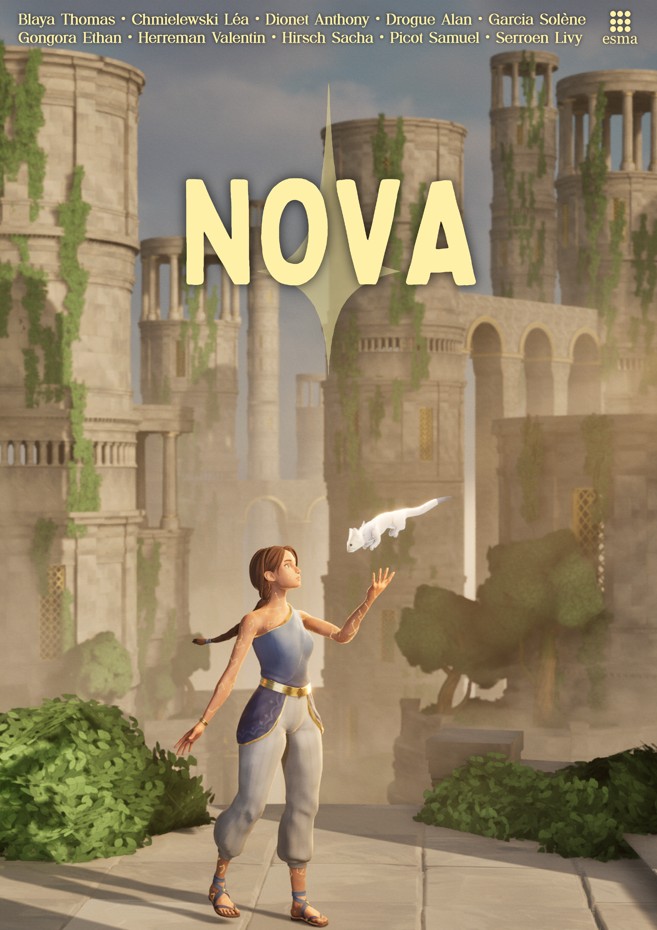
To find out more about the secrets behind the project, we spoke to Thomas Blaya, Léa Chmielewski, Anthony Dionet, Alan Drogue, Solène Garcia, Ethan Gongora, Sacha Hirsch, Valentin Herreman, Samuel Picot and Livy Serroen about this nine-month collaboration, in which each of them contributed their own personal touch and expertise.
How did this project come about?
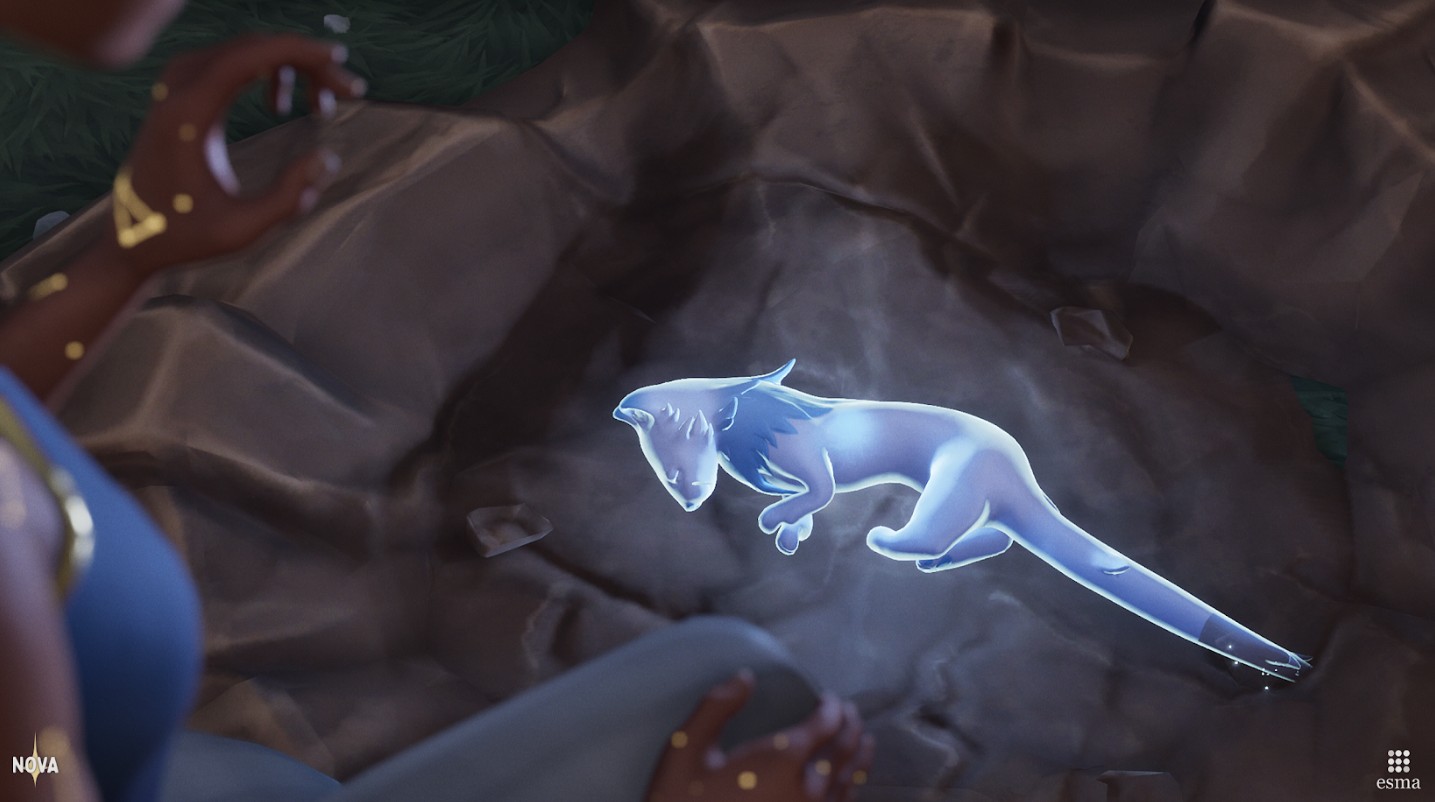
We wanted to create a narrative experience that was both poetic and spiritual. One day, an idea came to us: what if the moon was actually a magical animal, a sort of chimera between an otter and an ermine? From there, we imagined the story of a human civilisation and its downfall. Saving this moon-animal, which fell from the sky because of man’s selfishness, seemed to us to be an interesting way of getting the player to ask questions: what happened in this city? Why is it frozen, devoid of life? And why did these human beings act as they did?
How did your idea evolve from this concept?
We were inspired by poetic, minimalist adventures such as Journey, The Last Guardian and Jusant. We wanted to exploit the animal’s powers through magical interactions and lunar abilities, such as gliding or taking a huge lunar leap, and other mechanics that we unfortunately didn’t have time to incorporate into the game.
The idea was to create a relaxing platform adventure experience that gives players a feeling of lightness.
What guided you in your narrative, gameplay and aesthetic choices?
We set out to create an experience that was both minimalist and mysterious, and these two aspects guided our choices throughout development. The world we imagined is never fully explained: we wanted the player to question, observe and interpret the world in their own way. To achieve this, we’ve integrated a large number of visual clues into the environment and architecture, leaving plenty of room for curiosity and reflection.
In terms of gameplay, this same quest for simplicity has led us to reduce the number of actions and streamline the controls, to make the experience more fluid and accessible.
This minimalism has enabled us to create a poetic, calm and contemplative adventure that leaves the player time to feel, observe and reflect.
In terms of your characters, what were your inspirations or references?
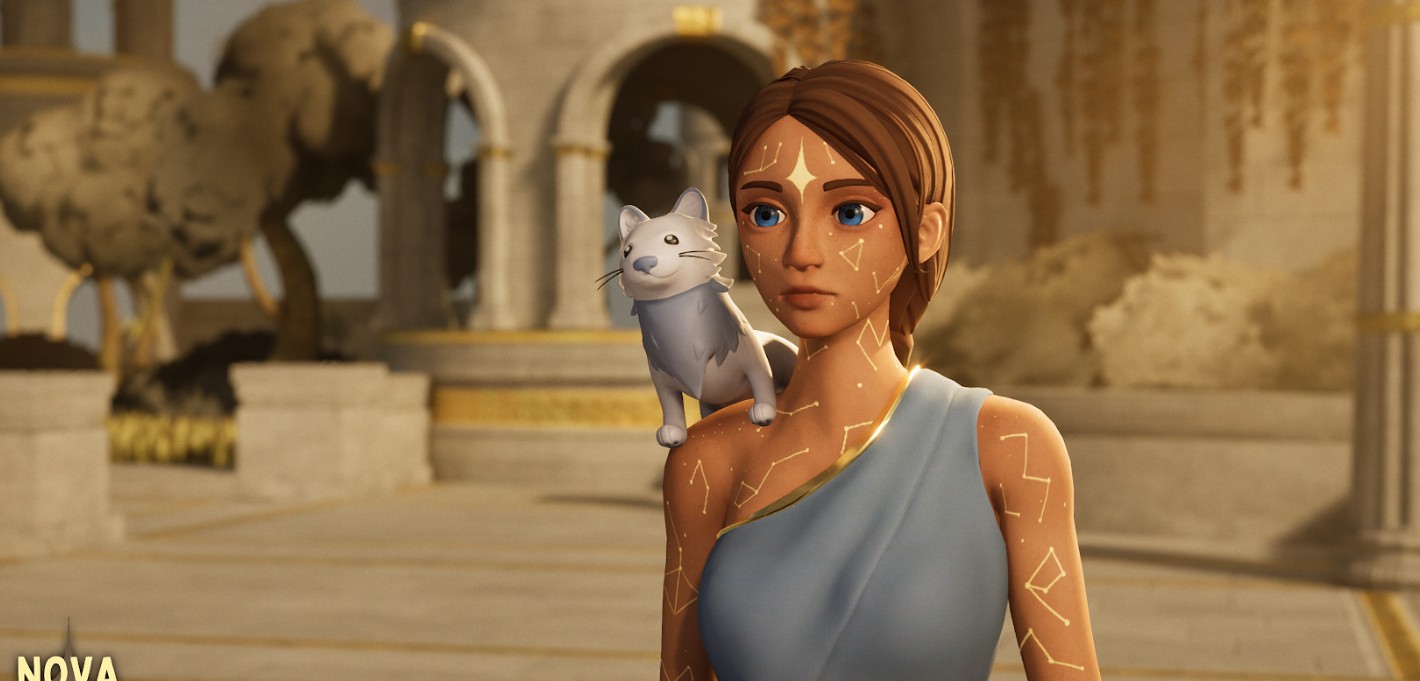
For Nova, we drew our inspiration mainly from the protagonist of the game Jusant, for his calmness, his trust in animals and his desire to protect them. Nova shares this serenity: she moves forward without fear, convinced that there will be a happy ending, no matter what obstacles she encounters.
Like Jusant‘s character, she is mute, which allows us to express the trust and deep bond she has with the animal without resorting to words. This choice also reinforces the mystery surrounding the play.
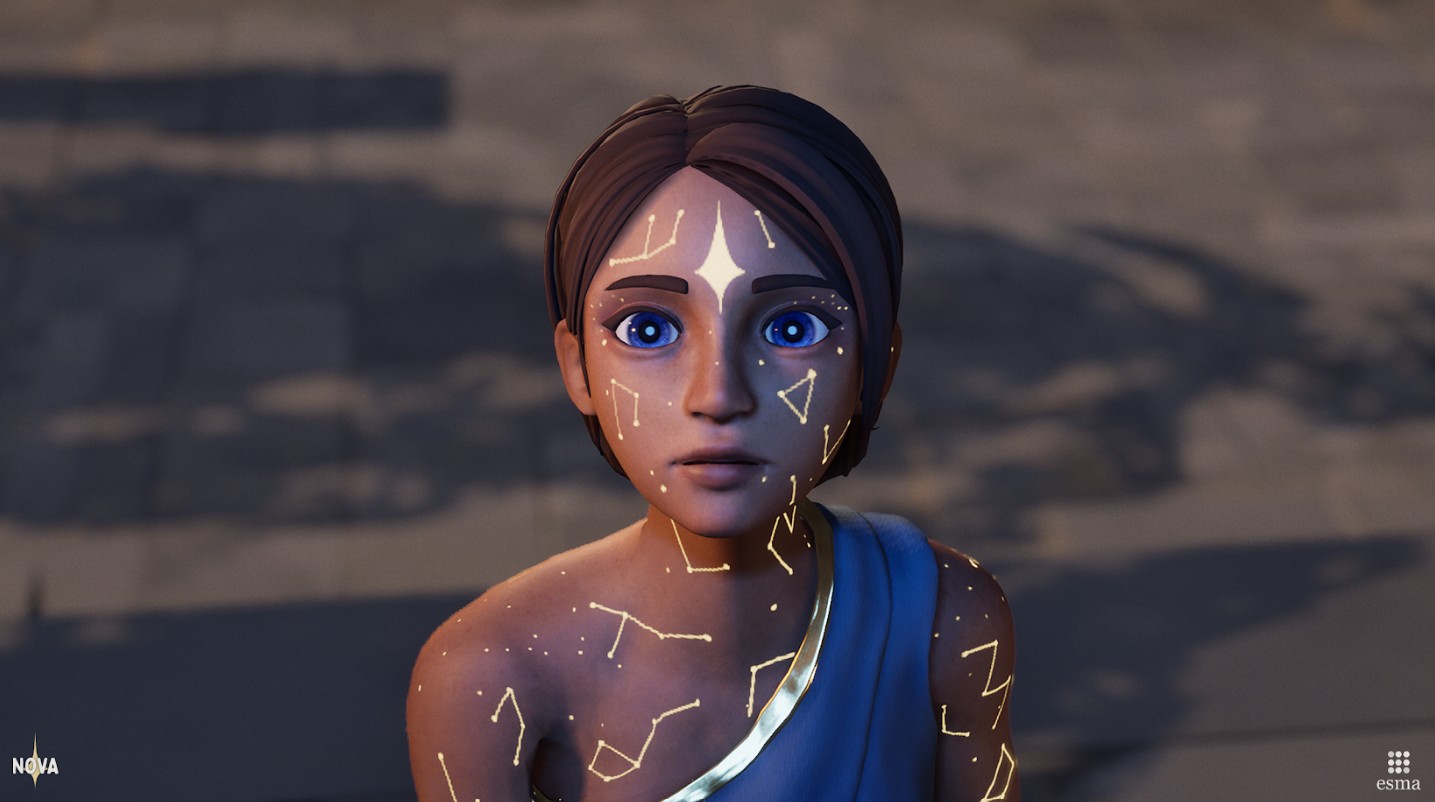
For the celestial animal, we chose to create a chimera inspired by the ermine, otter and fox. The ermine, for its delicacy and vulnerability, evoking fragility and purity. The otter, for its fluidity and lightness of movement, symbolising agility and grace.
The fox, for its intelligence and mysterious nature, reinforcing the creature’s mystical and unique aspect. We also drew inspiration from the Harry Potter Patronus, whose luminous, protective and mystical aura she shares. This influence has enabled us to design a creature that is at once endearing, magical and symbolic, embodying a strong link between the player and the game world.
To convey their emotions without dialogue, we had to rely on designs inspired by their personalities, the staging of cinematics, lighting and animation. For example, the celestial animal expresses itself through its movements, inspired by the otter and the ermine: it leaps into the void, floats, swims in the air, turns around Nova, and communicates through soft, ethereal sounds.
For her part, Nova always acts with restraint and benevolence, but we also sense her determination in her gestures and posture. All our work consisted in telling the story without words, so that each player could feel these characters in their own way.
How did you define the world of the game, and what were your visual or artistic influences in creating it?
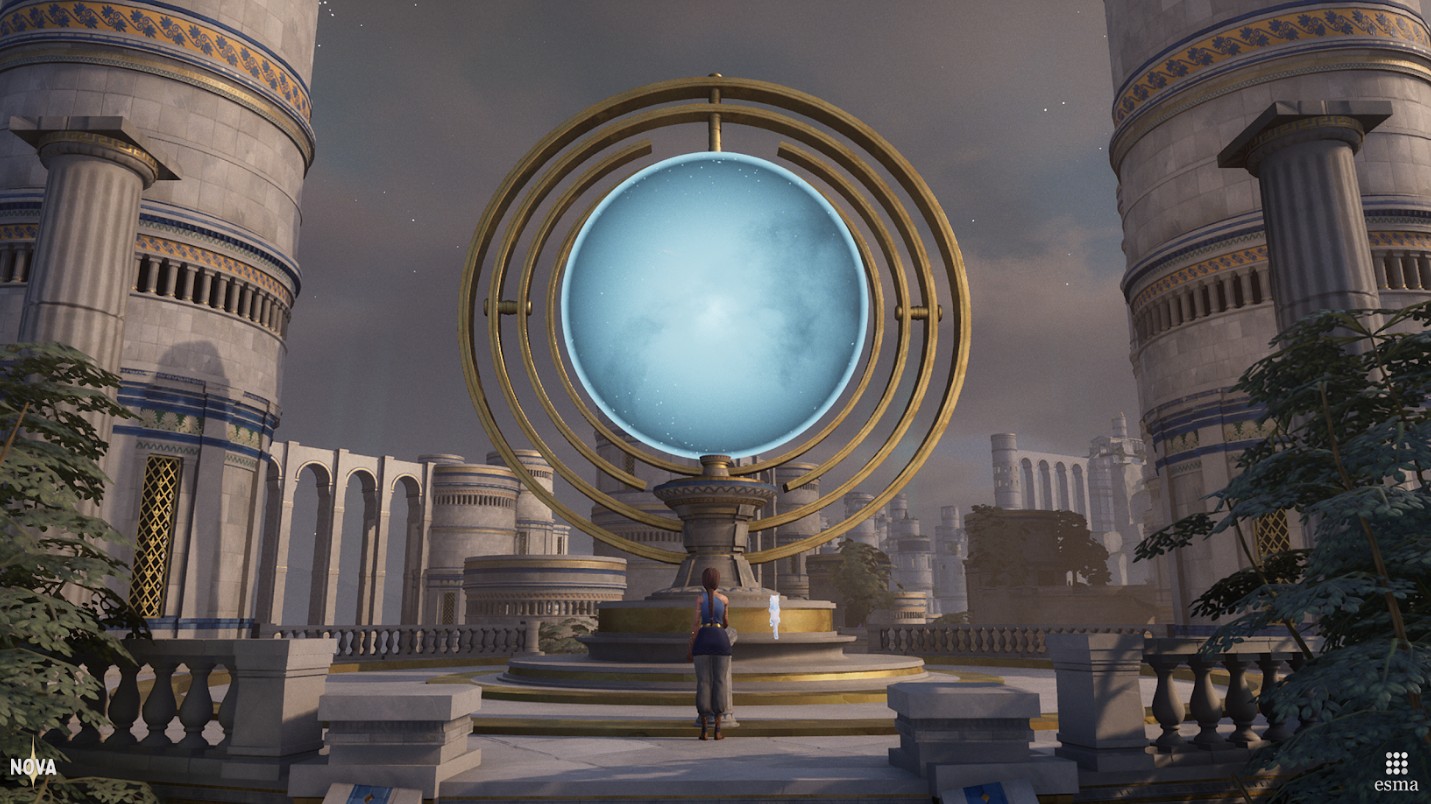
We wanted the world of Nova to be at once mystical, tragic and poetic. Very early on, we imagined an impressive city, marked by its immense towers and architecture inspired by ancient Greece, where astronomy and spirituality occupy a central place.
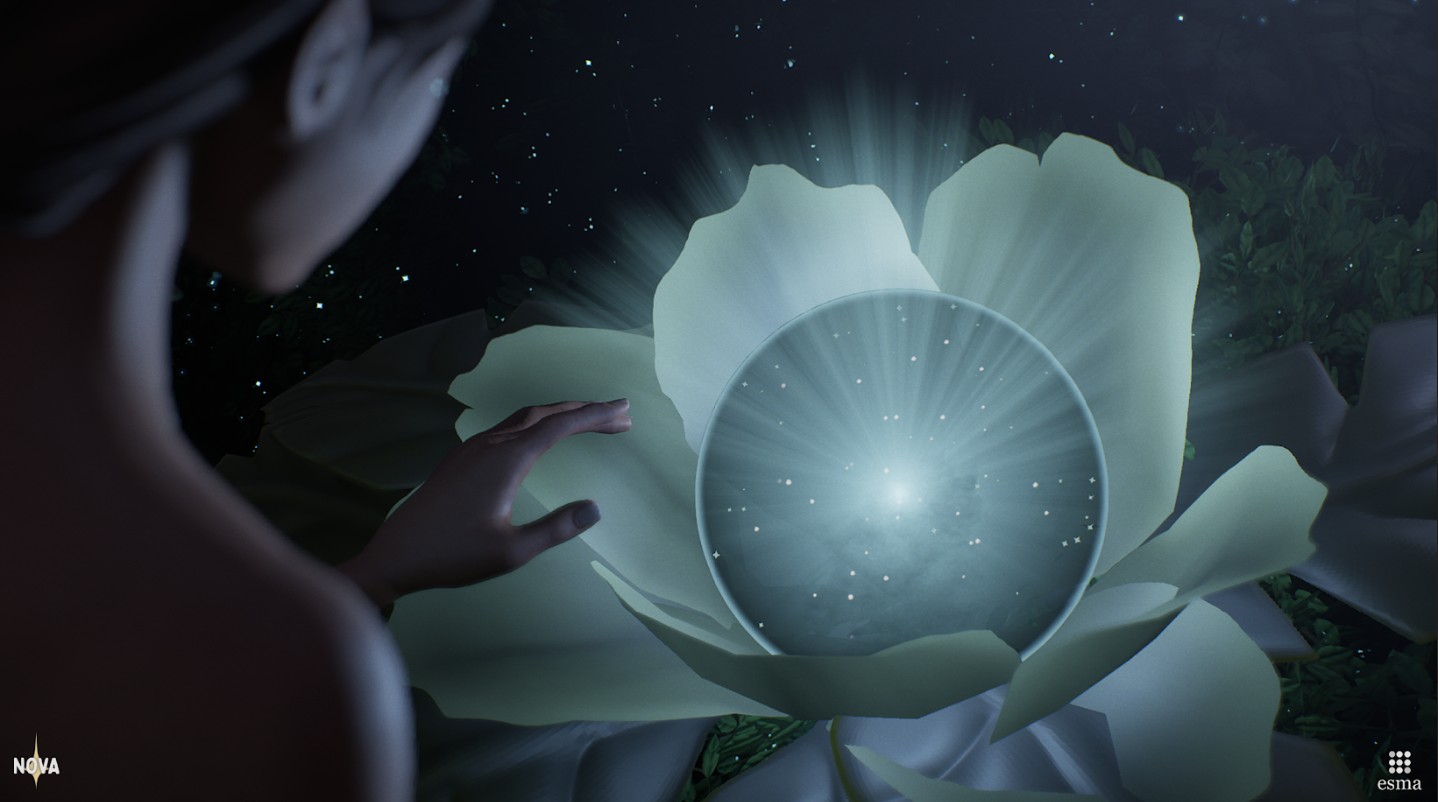
The idea was for the environment itself to become a vehicle for storytelling: statues, frescoes, engravings, light and music had to evoke the past without the need for words. Vegetation also plays an important role, as it reacts to the energy of the celestial animal, to which it is intimately linked.
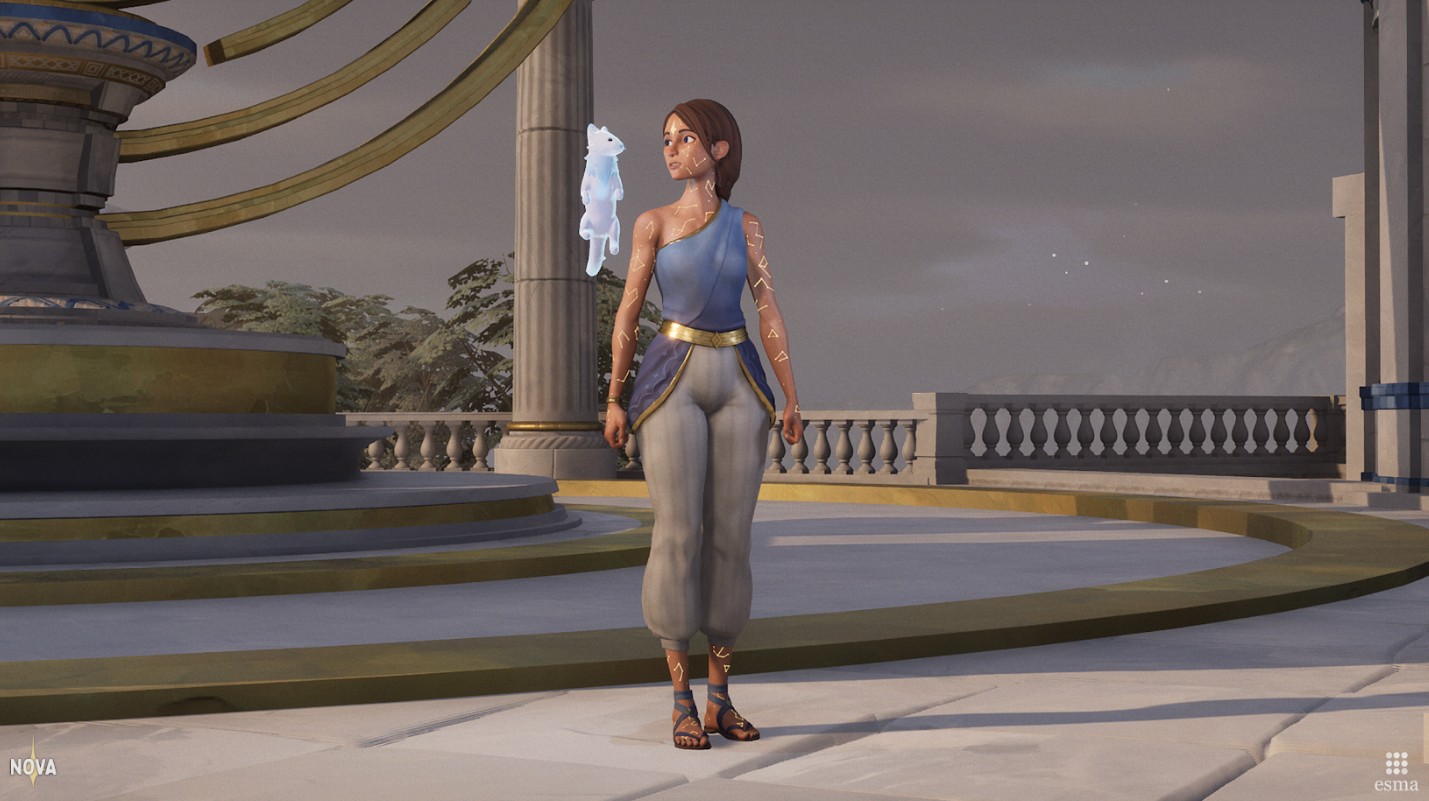
The city and its inhabitants, frozen in place, and nature, drained of its vital energy, create an atmosphere of calm after the storm, as if the world were on the brink of renewal.
Greek architecture inspired us by its grandeur and its ability to evoke a feeling of sacredness and solemnity. All of this is achieved through the use of vast settings that give a sense of solitude and a frozen world. We wanted the player to feel melancholy, grandeur and renewal as they explored the city.
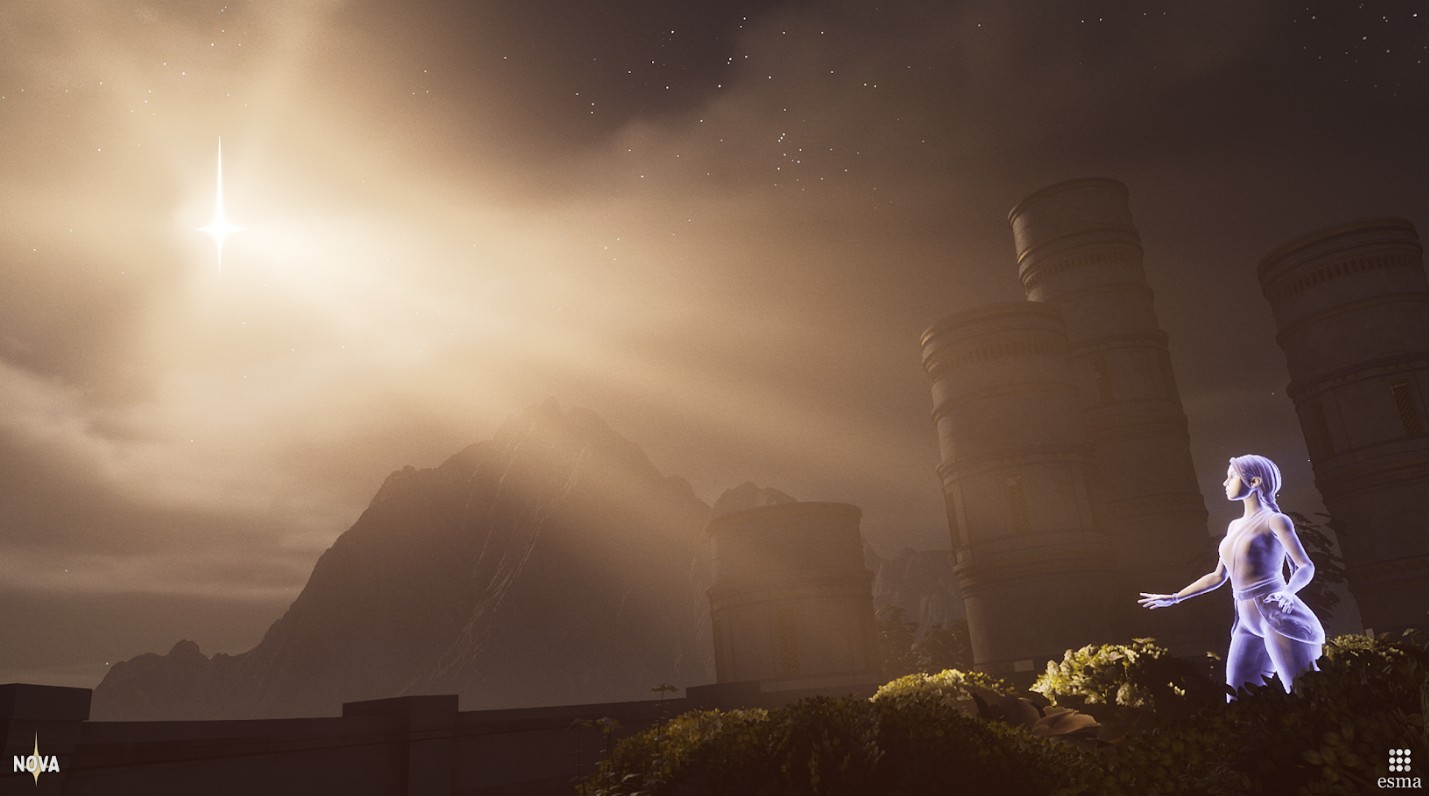
Lighting plays a major role in supporting the narrative and reinforcing the emotions. From the outset, we were inspired by paintings from the Romantic period, a movement that explores the human condition and emotions such as melancholy and tragedy. This is reflected in the diffuse, slightly desaturated lighting, accompanied by dense, misty skies.
What were the challenges in creating this city?
It’s mainly a question of level design. We wanted the progression to appear coherent, both with the destruction caused by the disaster and with the logical structure of the city itself. It was important to create recognisable areas that told something about the civilisation.
The real challenge was to be visually fresh, to retain a sense of discovery, and to create verticality and an interesting progression throughout the route, without the progression seeming artificial or repetitive.
Did you encounter any other difficulties during the production?
One of the biggest challenges was optimising the game. We wanted to create an experience with no loading times, with the city fully visible at all times during the game, while maintaining dynamic lighting and an immersive visual atmosphere.
It involved a lot of fine-tuning and balancing, but it also taught us a lot about optimisation methodologies and technical teamwork.
To resolve these various challenges, we had to take into account all stages of development, both artistic and technical. Firstly, we set up a visual production pipeline, with clear optimisation rules for the creation of assets, whether in modelling, VFX or textures.
On the technical side, we combined the Blueprint and C++ programming languages, which enabled us to strike a balance between rapid prototyping and optimised execution, especially for the more performance-sensitive systems.
For the lighting, we worked hard on optimising Lumen and shadows, adjusting fidelity, display distances and field distance parameters, to strike a balance between immersive ambience and performance.
Finally, we have adjusted the display distances of objects according to their size and importance in the scene, created LODs, and reduced the density of visual effects where necessary, activating effects only when they are visible, etc.
All this required a great deal of coordination within the team, but enabled us to maintain a balance between visual quality and performance.
How did the eleven-strong team work out?
Roles were allocated according to the area in which each member wished to specialise, so that each member could invest in what they were passionate about.
For certain more specific tasks, we have also taken into account everyone’s availability and wishes, so that everyone contributes in an efficient and motivating way.
Like any student project, there were moments of doubt, particularly towards the middle of production. Between the technical challenges, the tight deadlines and the ambition to create a game that was both visually and narratively rich, we were often afraid that we wouldn’t be able to finish everything in time. However, each difficulty has forced us to review our priorities, simplify certain elements and strengthen communication within the team. Setting milestones throughout the project gave us clear objectives to work towards. Thanks to this, we were able to organise ourselves efficiently and identify the points where work was most needed, and these adjustments enabled us to move forward together right to the end. But beyond the method, it was above all our curiosity and our desire to learn, as well as our desire to bring to life the universe we had imagined, that drove us forward despite all the difficulties.
What are you most proud of today when you revisit this project?
For having managed to see the project through to the end and bring it to life despite the many challenges. Nova was an artistic, technical and human adventure. It was the first time we’d worked in such a large team, and we learned a lot about how to collaborate and find a balance between everyone’s ideas.
At the end of the day, seeing the game exist, touching players and transmitting an emotion is what makes us happiest today.
What advice would you give to students who are making their games today?
Simply to enjoy the experience to the full, because it’s a rare opportunity to create your own game, from A to Z, with so much freedom.
It’s the ideal time to be daring, to try things out and to make mistakes. What sometimes prevented us from taking full advantage was our fear of not creating the experience exactly as we had imagined it. Today, we know that not everything will be perfect, and that this is normal. In fact, it’s often when things don’t go as planned that we learn the most.
Find out more about the Nova game, available here :