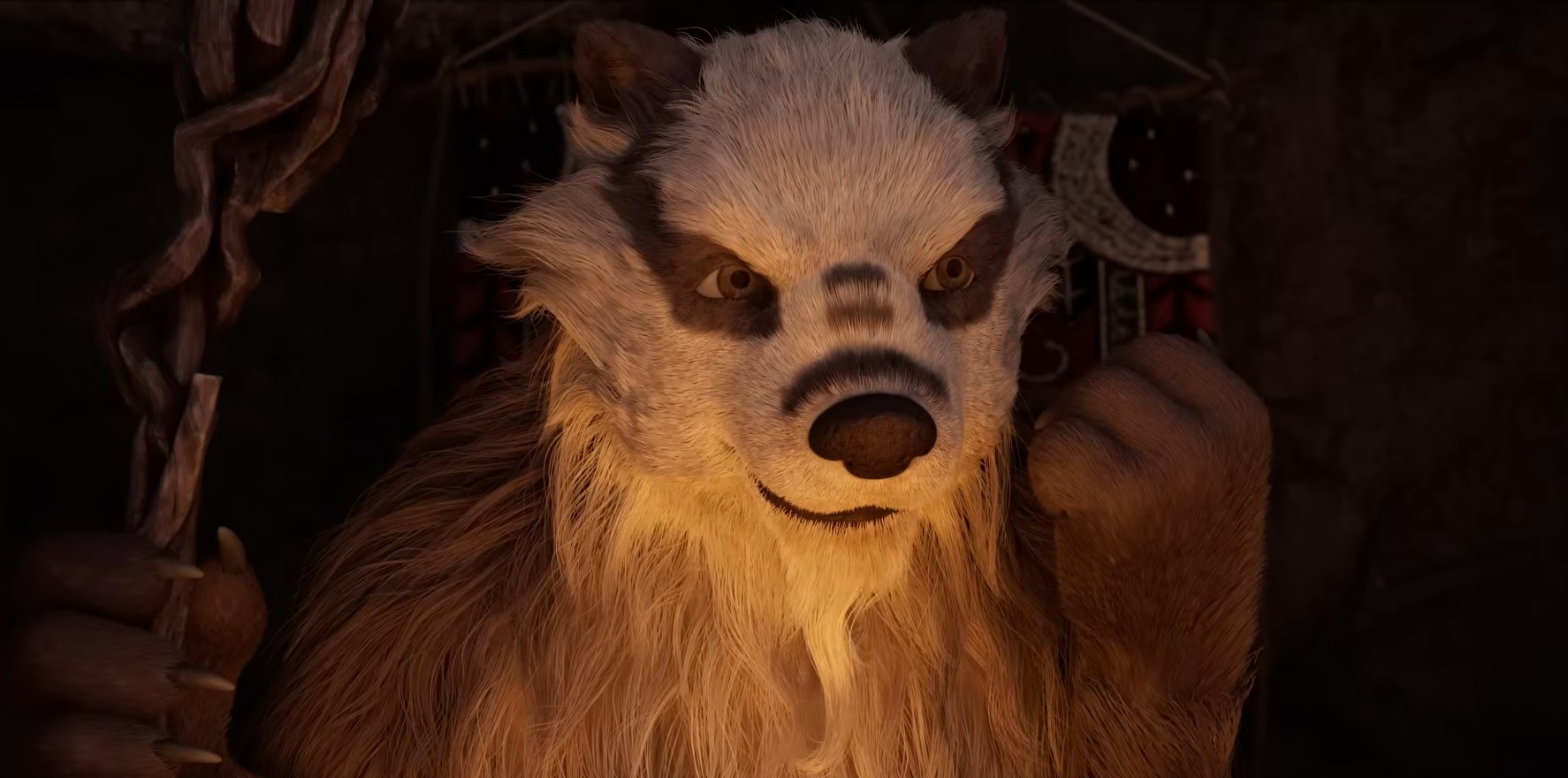

Intent on playing a practical joke on their friend Basile, Arthur and Paul lead the young badger on a quest to find Meles. But things don’t turn out as they expect…
Audience favourite at the ESMA Graduation Show 2024, Le Meles surprises with its dark, unforgiving atmosphere, and the atmospheric work that the team infuses into this harrowing tale.
It’s a brutal plunge into an equally brutal world, one that leaves a powerful impression on anyone who sees it on the big screen.
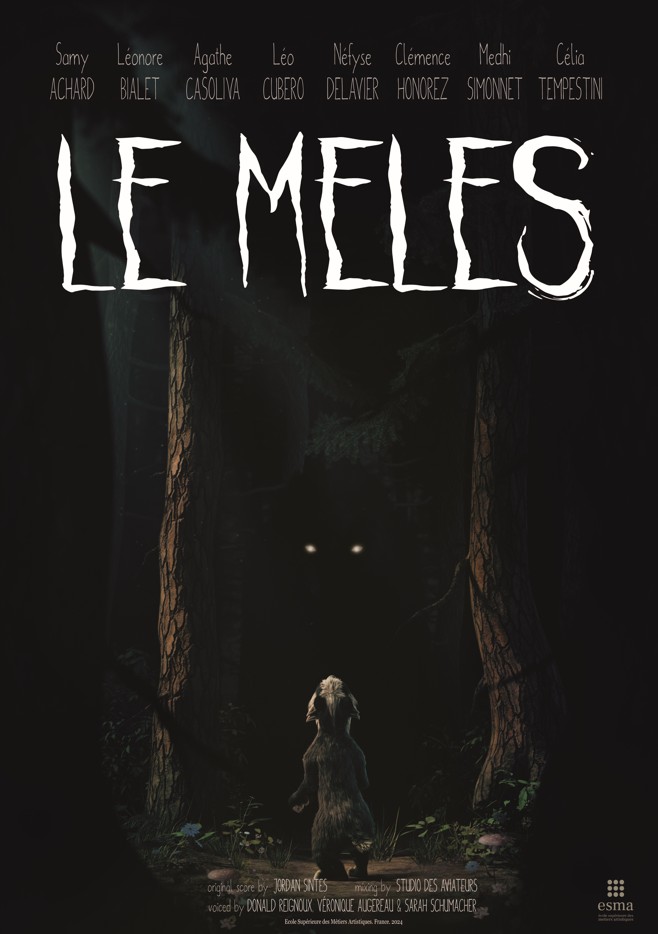
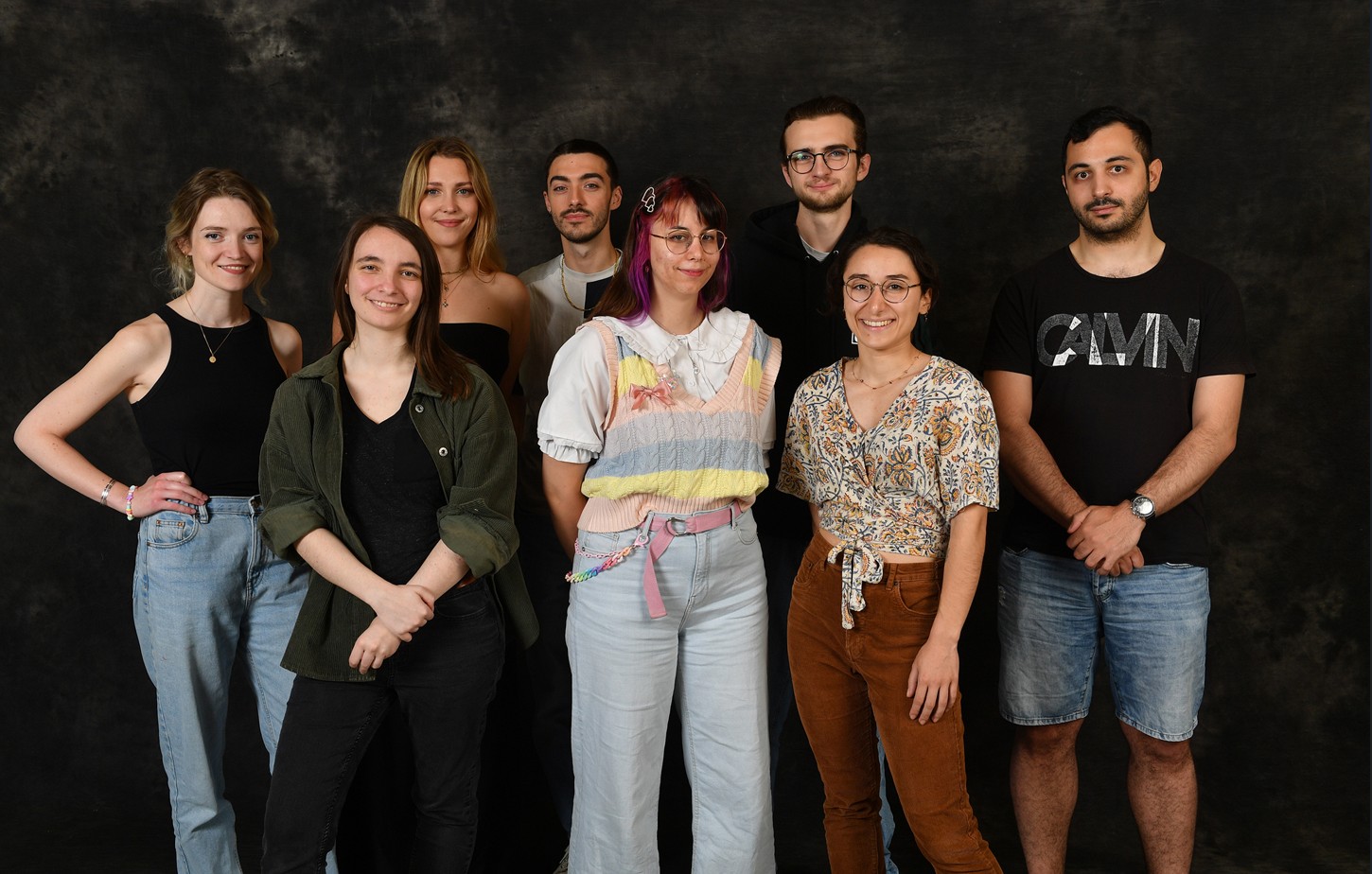
To find out more about the challenges involved in this production, we spoke to Léonore Bialet, Samy Achard, Nèfyse Delavier, Leo Cubero, Agathe Casoliva, Medhi Simonnet, Clémence Honorez and Célia Tempestini about this groundbreaking project.
First of all, congratulations on the film! Can you tell us how this project came about?
The basic idea was to take up the codes of cartoons aimed at a young audience, with cute little animals going off on adventures. Our main character, Basile the little badger, is bullied by his friends, and has to prove his worth to the others in order to fit in. But here, unlike the films we mentioned earlier, things end differently.
In terms of the creative process, we have to admit that our idea evolved relatively little between its birth and the final film. We remained faithful to our original vision. What we did do, however, was shorten the script considerably and scale up our ambitions to suit our small team.
What was important for us was to see the transformation of our creature on screen, and to see the little village of badgers in which our protagonists live.
Originally, we also had a fourth young badger who was to accompany the little troupe, much more in the background than the others but who remained passive in the face of the harassment of the youngest. Through this character, we wanted to get across the message that anyone who lets violence happen is just as guilty of it. But this was eventually cut in order to finish the film in time.
What guided you in your narrative and aesthetic choices?
We wanted to go for a realistic, and therefore dark, aesthetic. No bluish American night like we often see, just dark, very pronounced shadows. We wanted a raw realism to emphasise our point: in real life, not everything ends well.
The world of the film is that of a semi-realistic fable with a touch of rather gloomy fantasy. Here, magic doesn’t solve problems. It kills. Our most notable references were Mason’s Rats from the anthology Love, Death and Robots, for the stylised but realistic design of our characters, and the comic strip Scurry by Mac Smith, for the setting with its little animals lost in a forest where danger lurks behind every branch.
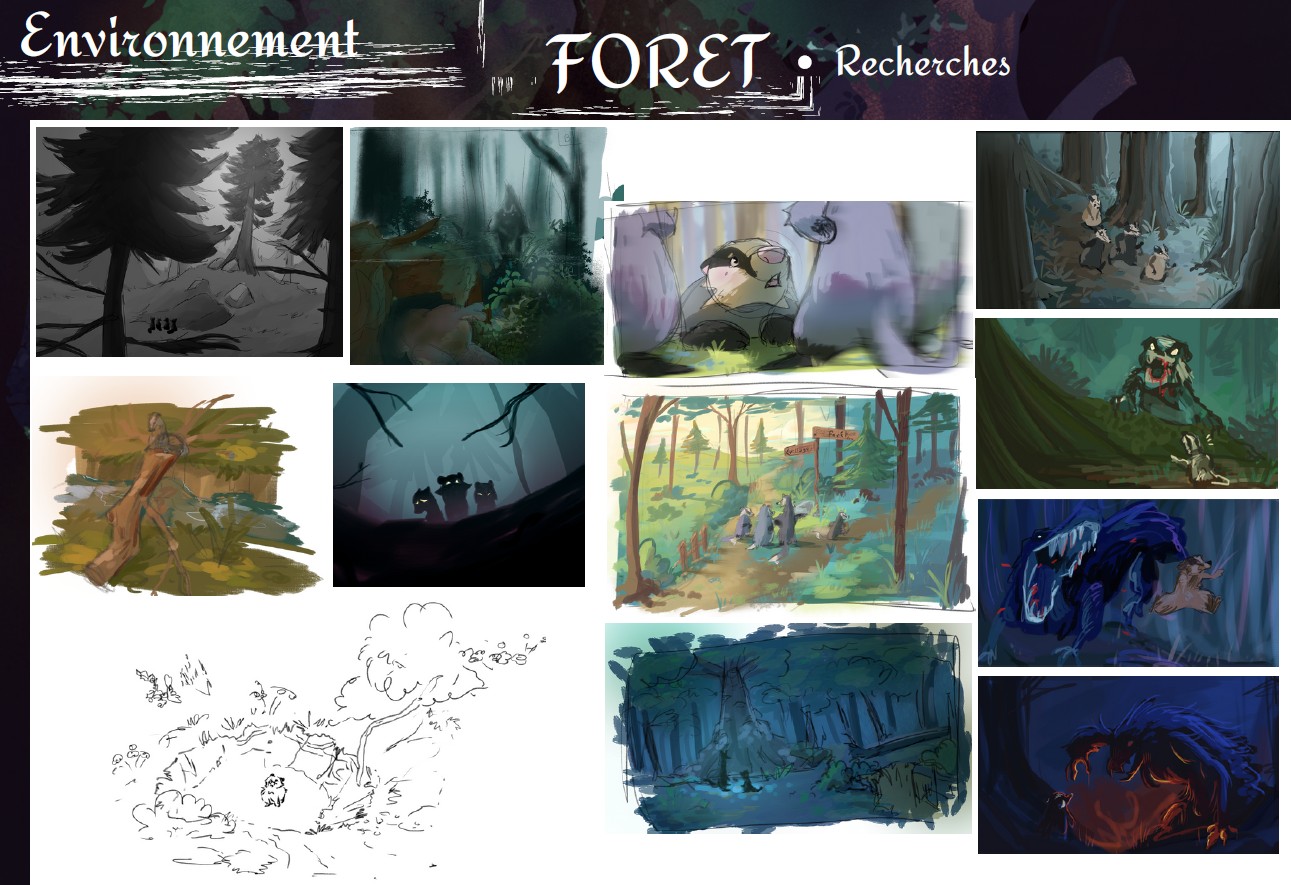
Speaking of the forest, it gave us quite a bit of trouble. You’d think that since the trees are randomly placed, there’d be nothing to worry about. However, they caused us quite a bit of trouble, from the beginning to the very end of production. Modelling such large conifers requires an enormous amount of resources, and on top of that we had to place them in such a way that they didn’t interfere with the visibility of the animation (while still sticking to our storyboard), or block our light sources! Our lightning artists were in for quite a surprise…
Can you tell us more about your characters?
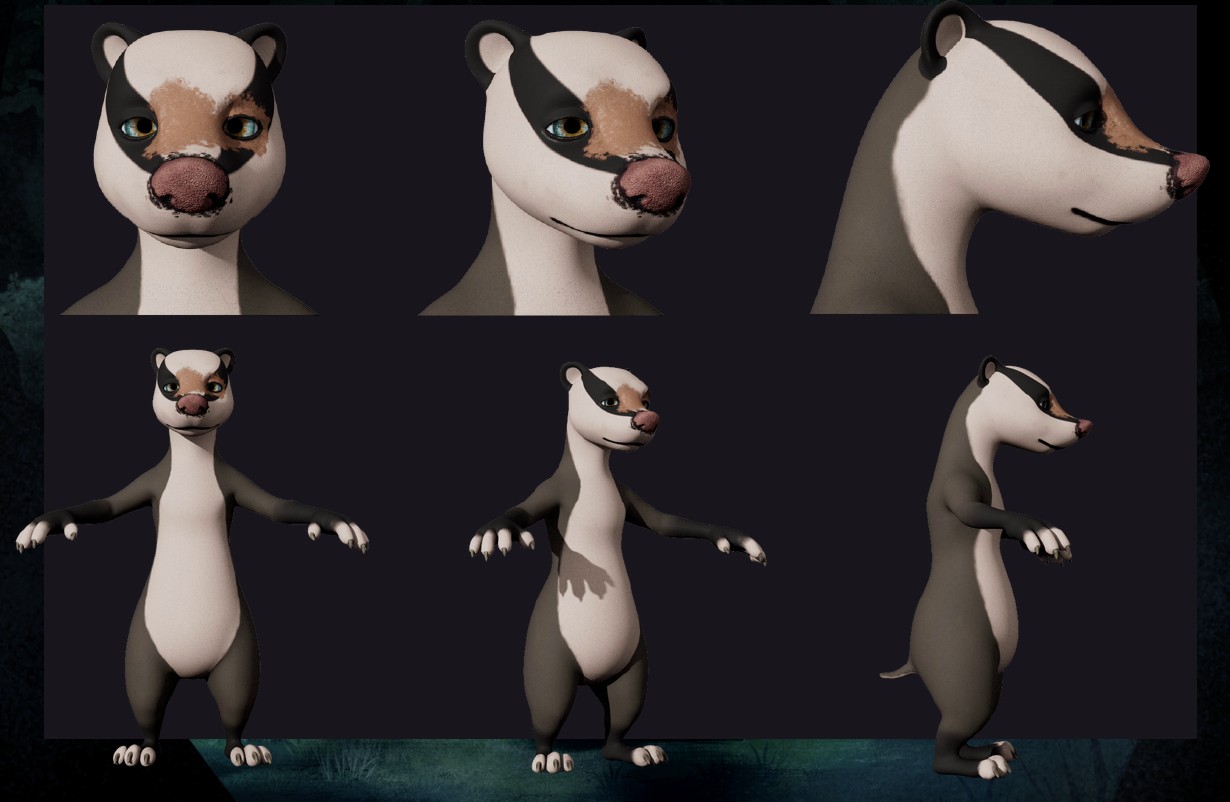
We played on fictional stereotypes to quickly introduce our characters. The smallest is shy and gets picked on. The taller one is mean and has his own underling to show him off and help him carry out his plans.
The smallest is shy and gets picked on. The big one is mean and has his own minion to show him off and help him carry out his plans. The wise shaman educates and guides the badgers.
To develop the latter, we took a close look at the shaman in the Disney film Bear Brother , as well as the witch in Rebelle.
We wanted a figure of wisdom who was both zany and authoritative. What was clear to us was that five minutes to present an entire universe, its characters, its stakes, its unfolding and get a satisfactory ending is an arduous task.
That’s why we’ve decided to use these script stereotypes to tackle a theme that’s familiar to everyone.
Many people were victims of harassment when they were younger, and taking up this theme here helps to make the connection with the public.
What were the main technical difficulties you encountered?
Our short film was quite resource-intensive, particularly in CFX with its five hairy characters and our famous forest.
To overcome these difficulties, we decided to work with a USD pipeline. This choice had an impact on all the stages of our pipeline, and meant that we had to use software that was different from what we were used to. To use it correctly and above all effectively, we were lucky enough to benefit from appropriate coaching.
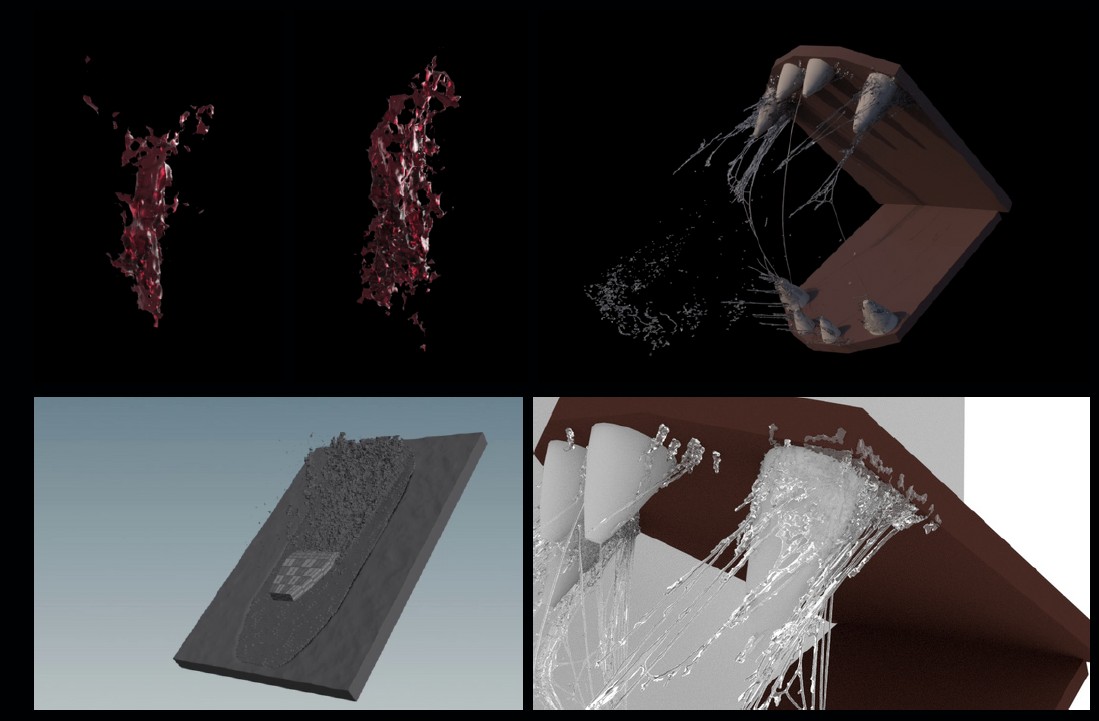
In human terms, our team also came up against an imbalance due to different specialisations from those needed for our production. Each member of our team was specialised in the skills they had acquired during their studies at ESMA, but we only had one lightning artist and one fx and comp artist.
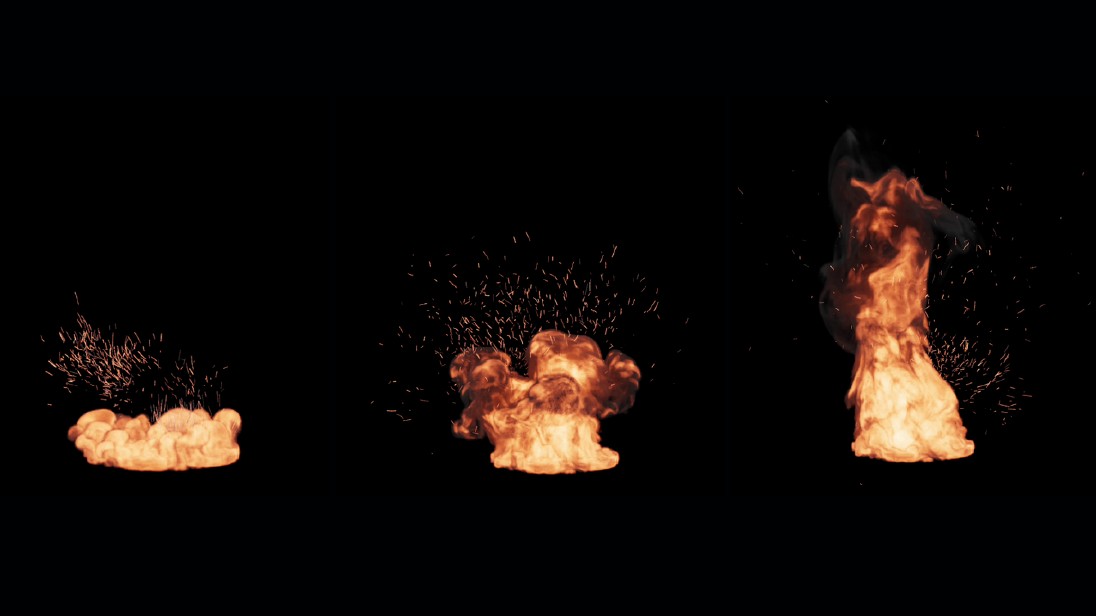
In addition, one of our members suffered from health problems and had to leave the team a few weeks after the start of the new season. Finally, we’ve all dabbled in grooming along the way, but never in depth.
To overcome all these difficulties, we have each learnt new skills, so that we can share tasks more effectively and lighten the workload of our lead artists.
We were also able to count on the help of a number of external contributors who accompanied us (as for the cfx, for example), and we were lucky enough to welcome a comp assistant at the very end of the production.
Was there ever a time when you thought the project wouldn’t go ahead?
Of course we did. We had a lot of doubts about the ambition of our project, especially from the teaching staff who begged us to scale down our aspirations so that we could release the film. We listened to most of them, but we never lost sight of our goals, and above all we never gave up. It was our tenacity (and the fact that we’re a very stubborn team) that enabled us to complete the project. We were determined to prove people who didn’t believe in us wrong. So we did it, and we even won the Audience Award in the process.
What are you most proud of today?
To have managed to finish the film, to be satisfied with it. It’s difficult when you get to fourth year to see yourself capable of producing a short film on your own, there are so many things to do that you don’t know where to start.
Seeing him today, after having doubted our own abilities and given so much of ourselves and our health to bring him into the world, is also a source of pride.
Do you have a production anecdote to share or a memory that stands out in your mind?
With hindsight, we modelled and rigged so many props that didn’t end up appearing on screen. At least three different sceptres for our shaman and a staff that our stalker was supposed to use to hit little Basil, all of which went by the wayside.
Not to mention all the furniture and knick-knacks in the shaman’s lair that our only renderer spends weekends texturing, and which eventually go unnoticed because they’re hidden by a character or by the dark atmosphere of the lair.
A word of advice: plan your layouts better than we do.
Discover LE MELES, ESMA’s 2024 graduation film, now available in full: