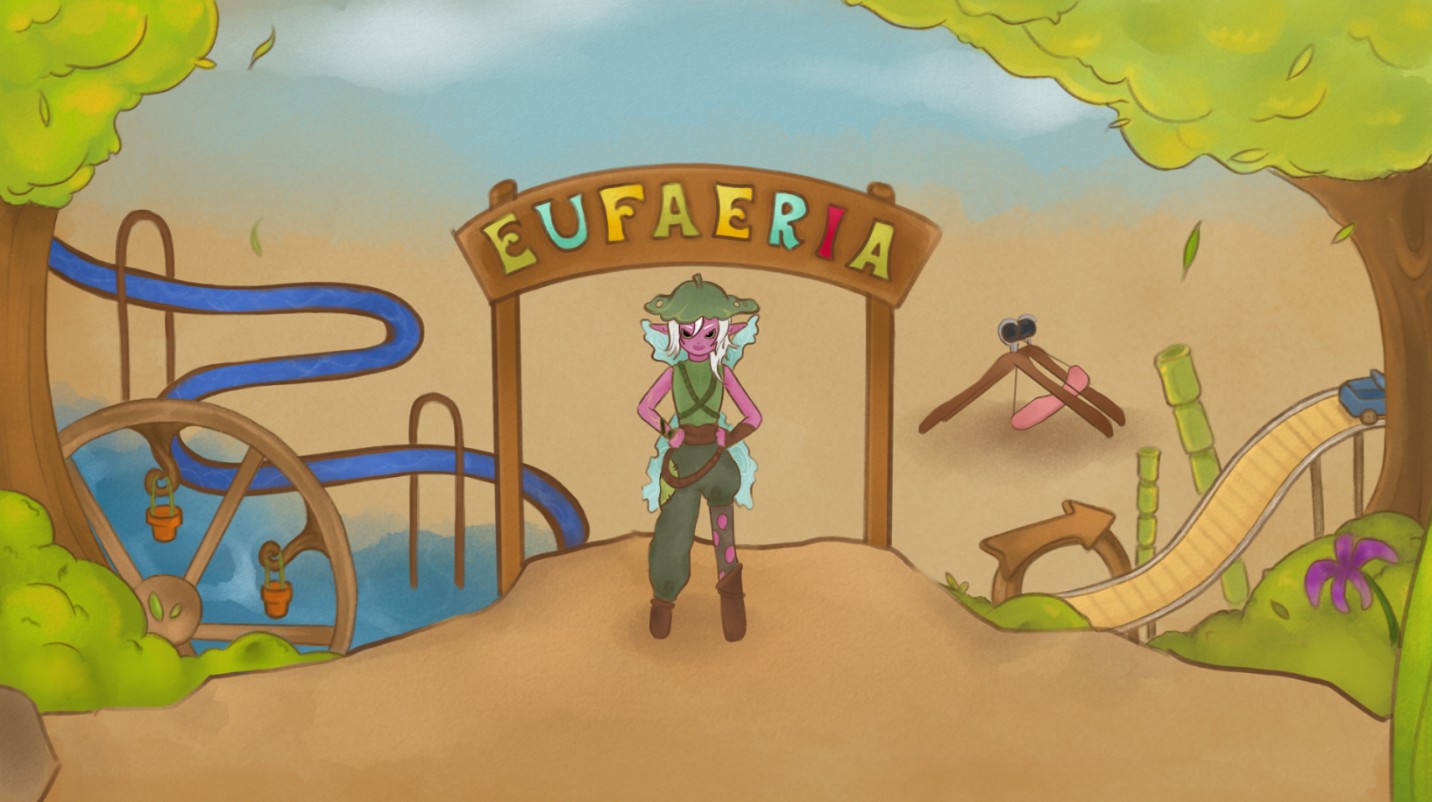

Armed with the power of telekinesis, it’s up to you, a somewhat brutal fairy, to exterminate this vermin. And with whatever you can get your hands on.
By playing with the codes of the enchanted forest, the Tiny Kinesis team has created a joyful contrast between a bright, fairytale world and the gameplay of a game as violent as it is explosive.
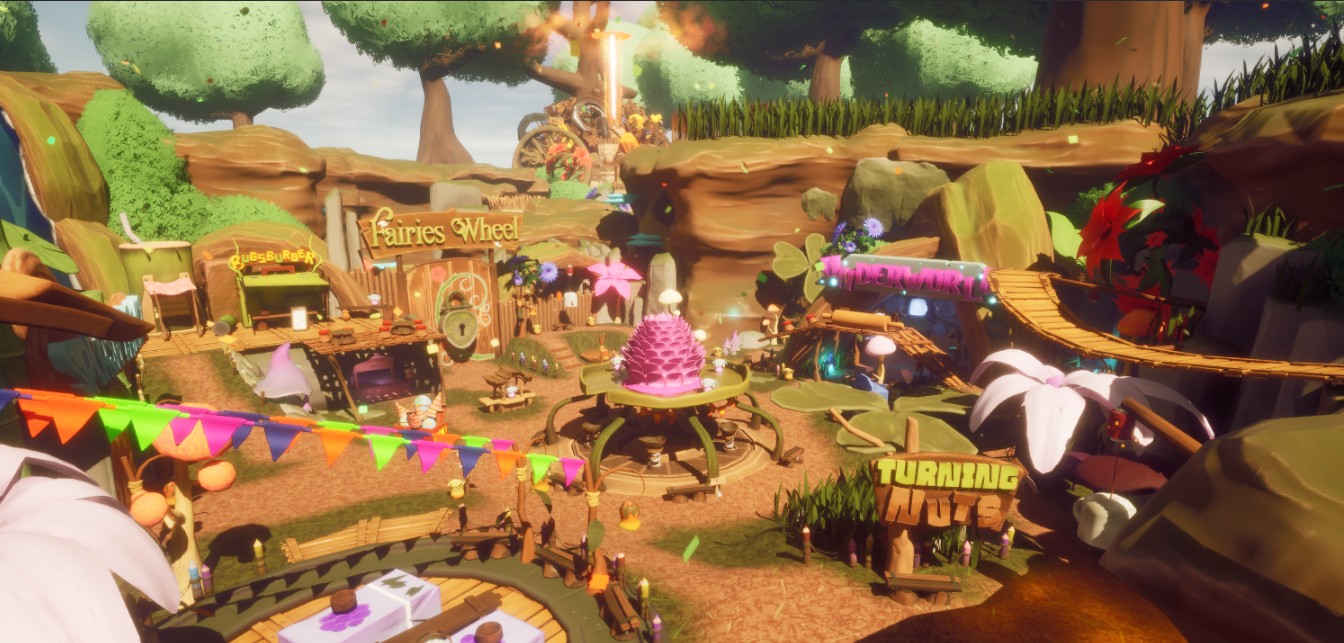
A unique proposition that won over the ESMA Video Games 2025 jury and won the prize for best gameplay.
How did the team, made up of Clément Beuselinck, Yann Chatila, Guénolé Coulon, Lisa Dumaine, Léo Gauthier, Elisa Oury, Juliette Reynaud, Alexandre Riallot, Marisa Sutachun and Mathis Verrechia, aka ‘Wizard studio’, manage to pull off this tour de force? Find out here, as we delve into the creative process behind this unique student video game.
Devilishly effective gameplay
To build this game, the team established its core loop (i.e. the set of actions that the player continually repeats to progress and engage in a game) fairly quickly. The player’s objective is to progress through the park, while fighting the hordes of enemies that assault him as each zone is discovered.
Each zone has its own ‘arenas’, in which the player must defeat hordes of enemies using a variety of techniques that test both dexterity and tactical ability. Each time you succeed, you unlock new areas and discover new tactics for defeating the ever-growing number of tough enemies.
It’s a simple principle, but one that, when combined with inventive gameplay based on the use of telekinesis and destructible objects and scenery, gives the game a real edge.
“Our ambition was to find a balance between the fairytale atmosphere of a universe likeArthur and the Minimoys at Europa Park, and the frenetic gameplay of a game like Kena: Bridge of Spirits, whose universe inspired us just as much,” explains the team. “Through these rich, lush settings, our character can evolve while using traps and projectiles to overcome the many enemies who get in his way.” It’s an action-packed, beat ’em all adventure that’s great fun to play, thanks to the advanced graphics and meticulous art direction.
Attention to detail
Taking their work as far as their communication tools – the graphic bible and the Game Concept Document – the team took care to create a real world around their game, beyond the screen. A pleasure to discover, and the mark of a professionalism that augurs well for the future of these freshly graduated students.
“We drew inspiration for our game from worlds such as Arrietty and the Little World of Tinkerers from Studio Ghibli, or Tinker Bell and the Fairy Expedition, but also from other videogame environments such as those of Tinykin or Grounded ,” says the team.
“In a world where humans have disappeared, fairies still use the human objects that surround them in their daily lives, and that’s where our player evolves. It’s a visually striking world, using bright colours and a hand-painted style, a feeling that’s reflected in both our textures and our approach to modelling our assets.”
Drawing an invisible heroine
As in many first-person games, it’s through the character’s hands that we meet the rebellious, gruff and brutal fairy embodied by the Tiny Kinesis player. “We imagined him as a character on the fringes of society, isolated from his peers.
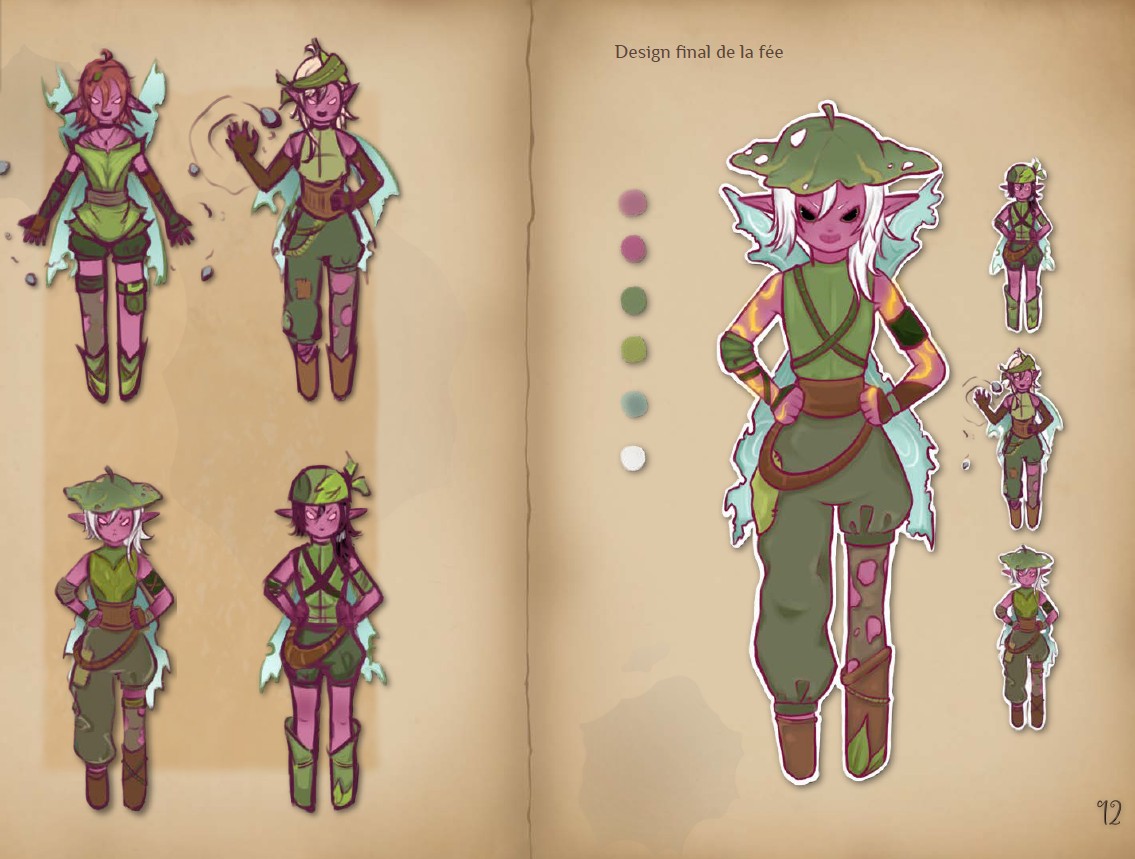
She is known in this universe as a fairy who is not afraid to get her hands dirty, and who uses her telekinetic powers in a very special way.
In terms of design, we were also keen to play on asymmetry, to break up the overly smooth look and bring diversity to our models.”
This determination is reflected in the character’s hands, which are clearly distinguishable and each dressed in different colours and finery.
From gremlins to gnomes, creating a wide variety of pests
Faced with this protagonist, who is determined to do battle, hordes of enemies (the “pests”) follow one another without resembling one another. Small masked beings give way to strange nocturnal creatures, while mushrooms and nature inspire even stranger monsters.
But it was the little masked goblins that our team spent most of their time working on, creating beautifully crafted 3D models in ZBrush. By varying the shades and colours, the team were able to give these little creatures a wide variety of forms, creating a veritable festival of cute but devilishly invasive creatures.
A credible environment, between nature and Disneyland
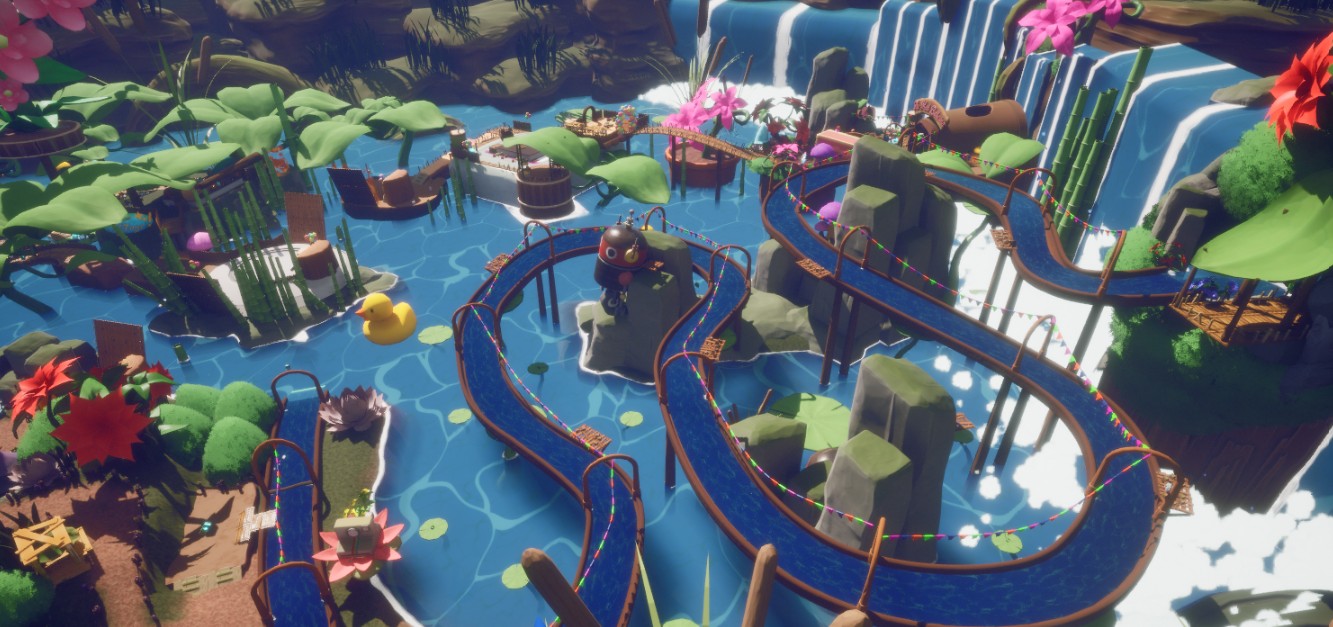
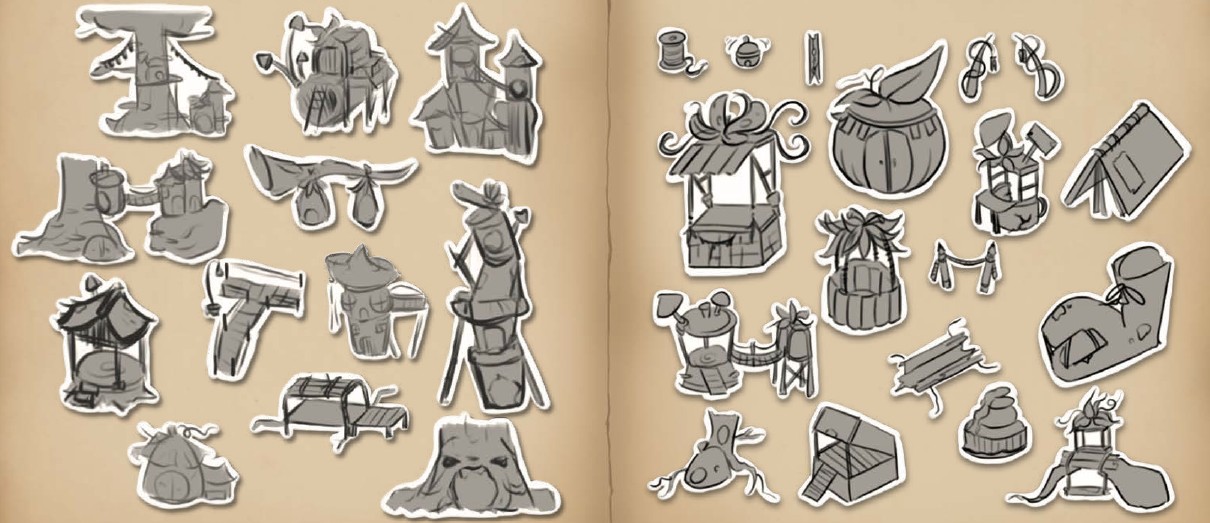
To bring their world to life, the Tiny Kinesis team drew inspiration from both nature and amusement parks to create the many sets, Ferris wheels and roller coasters that make such an environment so special. “Like any amusement park, there are always food stalls and souvenir stands at the entrance and exit,” adds the team, who also modelled insignificant scenery elements that lend credibility to this forest world. “In our world, small human objects find a new use for fairy creatures: a spool of thread that serves as a table, a house in a boot, pencils that serve as barriers, and so on.
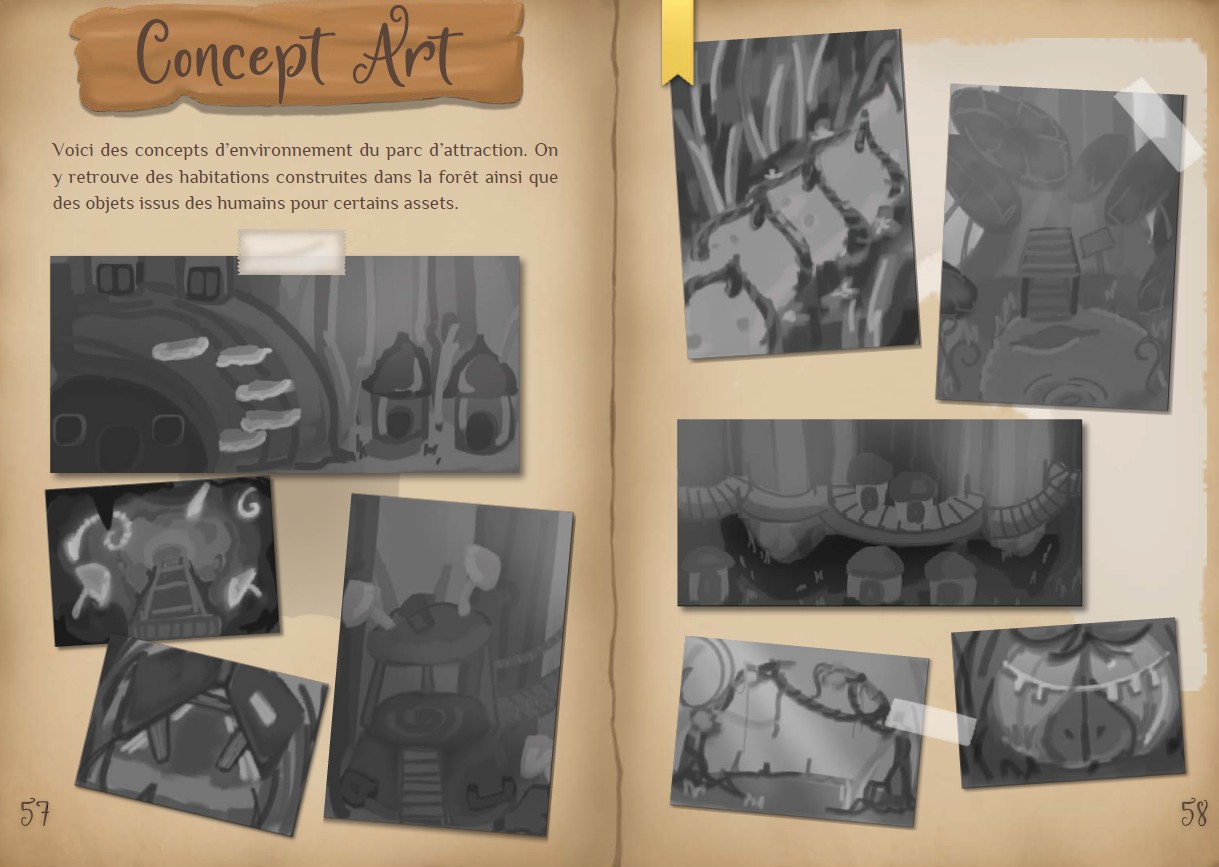
The environment plunges us into an amusement park set in a forest, around a lake and in the heart of a burrow transformed for the occasion. Each area of the park differs in the way it is used, the elements it contains and the way it is used.
The new exhibition will not only be a great place to visit, but also a great place to feel the atmosphere.
Design an interface in keeping with the game’s universe
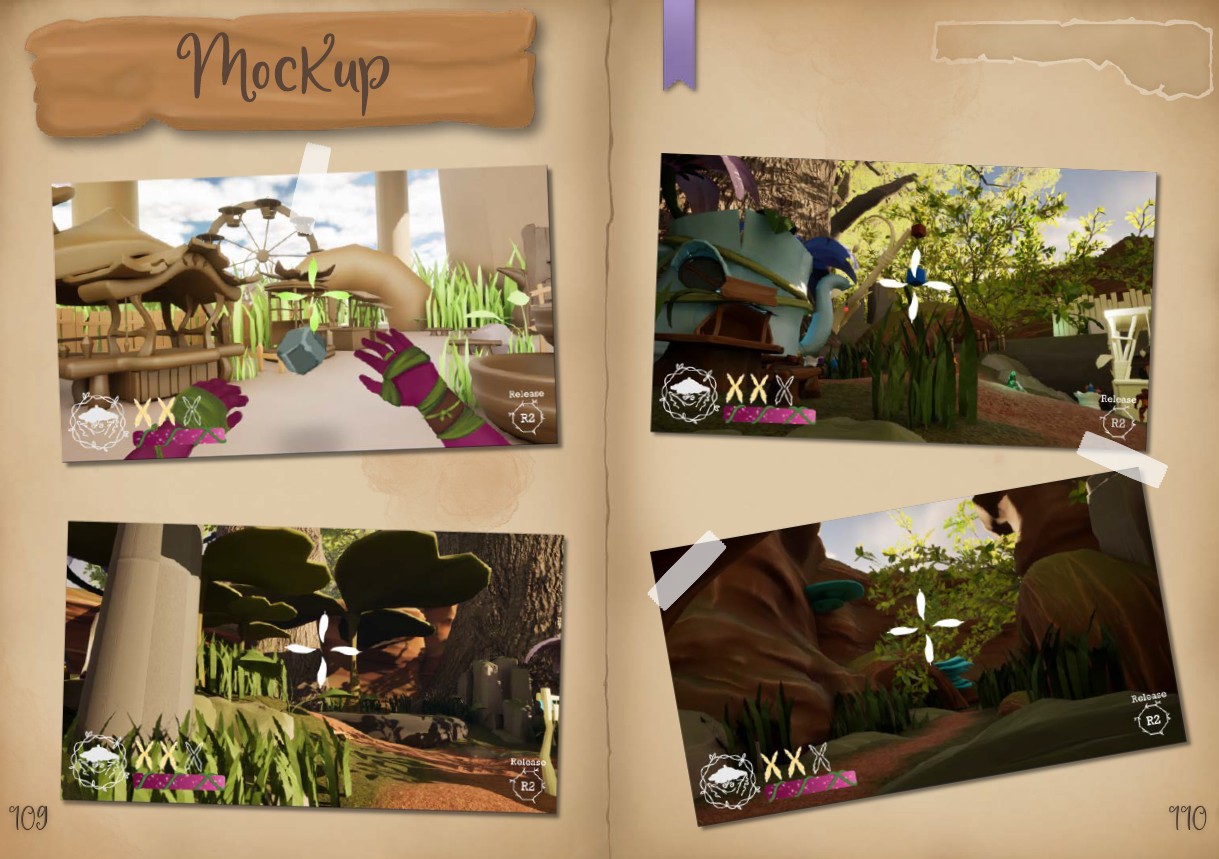
A good game is not enough to convince the public, far from it. The interface, menus and in-game displays such as the life bar, jump indicators and energy gauges also play an important role. To design these, the team based itself on the look of the characters, the environment and the general graphics already established.
“For the crosshair, in other words the indicator that guides the player’s movements, we did a lot of research into the motifs already present in the game. The Ferris wheel, fairy wings and vegetation. We opted for white-coloured leaves, which are visible on the mock-up and easier to use in the various settings. Some of the other suggestions ended up being used as icons for the map or frames for the user interface.
Far from the tinkling of the fairy bell
Finally, to add the final touch of immersion needed in this universe, the sound treatment blends the fairy-tale, joyful world of the theme park with strident sounds and hectic music, reinforcing the nervousness of the battles. “It’s a way of underlining the player’s powers and the danger of the situations, which contrasts with the gentle world and childlike sounds that resonate in the park”, concludes the team.
At the end of the day, Tiny Kinesis is a unique achievement, a powerful proposition put forward by a talented team, which won over a panel of professionals and now serves as a quality calling card for its creators.
Find out more about Tiny Kinesis, available for free here :