
It was an experience that left a deep impression on Arthur Barbu, Gaëlle Bescond, Bastien Bodere, Mathieu Chartier, Nayle Diouri, Léo Ferron, Natael Forget, Bran Marchaland, Mathis Miriel, Hugo Pierre and Nicolas Veinand, the eleven students who made this ambitious project a reality.
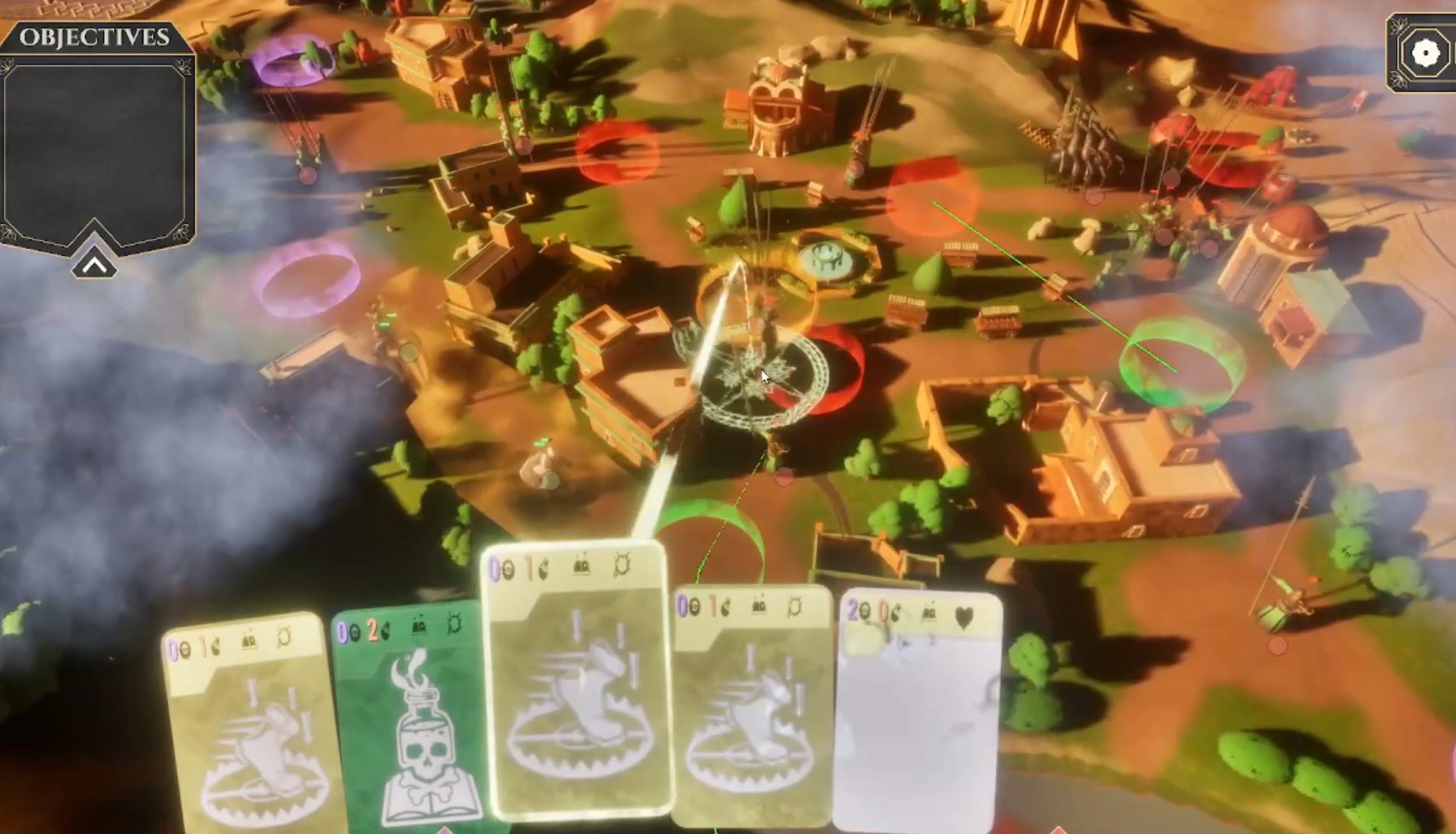
In Maps & Cards, you take on the role of a mercenary commander tasked with defeating enemy armies. To accomplish this mission, you’ll need to use cards to summon your soldiers or apply various effects, all the while using your resources wisely and choosing your actions carefully, in order to progress through the story and achieve your goals.
To gain a better understanding of this development process, we spoke to Mathieu Chartier about the various stages that led to the completion of Maps & Cards, which was presented at the ESMA Video Games Grand Prix last June.
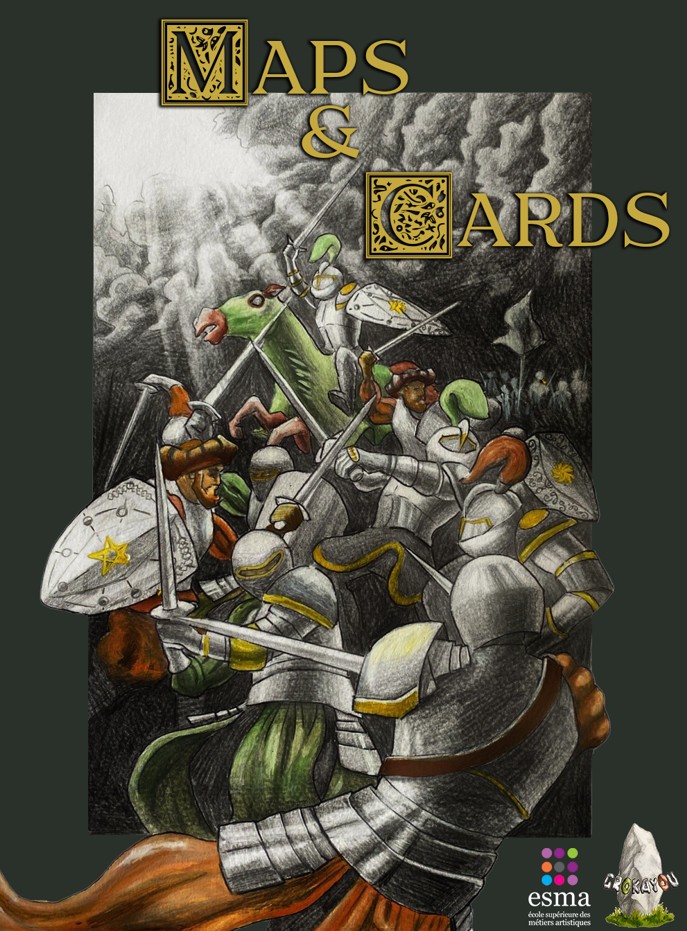
A cross between TCG and RTS
From the outset, Maps & Cards was born of an alliance between two proposals presented as concepts by students at ESMA Rennes. “Our game was born of two ideas”, recalls Mathieu Chartier. “Firstly, that of a Trading Card Game or TCG[Pokémon, Yu-Gi Oh, Magic, etc.], and at the same time our desire to create a real-time strategy game (or RTS) in the style of Age of Empires or Company of Heroes.”
From the outset, Maps & Cards was conceived by the team as a cross between these two player profiles, targeting two audiences while offering a unique experience through short, accessible game sessions.
A singular challenge, which then had to be built as a team.
Staying on course
Mathieu Chartier is still thinking about a production that is struggling to get off the ground, given the scale of the task. But despite everything, it was thanks to regular teamwork that the eleven students working on Maps & Cards were able to bring their project to a successful conclusion. “Admittedly, production was a bit chaotic, but we kept to our main theme, which was to focus on a relatively unknown period of military history, namely the 16th-17th century and the era of pikes and muskets, giving our game a unique character.
Then, thanks to board games such as Risk and other strategy games, we were able to balance the different powers of our cards and their effects, and come up with a game mechanic that was effective and fun to play.
Among their influences, Mathieu of course cites Hearthstone and Age of Empires, but also classics such as Starcraft, whose reputation is well established.
Building a simple but compelling world
In Maps & Cards, speed of thought and speed of reaction are important for successfully building your army, controlling battlefields and deploying the right cards at the right time to turn the tide of battle and crush your opponents. “This balancing act and the feel of the game were our biggest challenge,” says Mathieu Chartier. “Being able to create these combos, while giving our players a real immersion in this period of military history of the ‘pike and shot’ [infantry formation mixing pikes and firearms or throwing weapons] remixed with light fantasy elements.”
It’s a real success, with its hectic pace and shimmering colours inspired by Tunic, the action-adventure game released in 2022, as well as the Ottoman and Byzantine architecture that inspired the production.
“Defining an artistic direction is a real challenge,” says Mathieu. “But once we’d chosen one, it gave coherence to our universe, while giving the team a common thread.”
Try, learn and get organised
When eleven people work together on a project of this intensity, it is of course necessary to structure their work and organise their teams. The students at Maps & Cards learnt this during the creative process, and have had to rethink the way they work to best suit the needs of the project and of each individual.
“Initially, we had established that decisions would be taken collegially. But with several strong personalities in our group, cohesion in this organisation was a serious challenge, and this had an impact on our thinking about the artistic direction. To remedy this, and overcome the difficulties but also the technical challenges that a project like this represents, we held numerous meetings and restructured our work dynamic.”
From a completely horizontal process, the team has moved to a system of cluster leaders, to speed up decision-making and make the workflow more efficient.
In the end, the leaders were given more responsibility, and it was through them that decisions were taken for each of the positions for which they were responsible.

“Of course, we had our moments of doubt, both individually and collectively”, adds Mathieu, “but I personally think that it was the group’s perseverance and the fact that we kept creating and seeing our improvements as the project progressed that helped me maintain my motivation and bring this game to a successful conclusion”.
Her advice? Don’t put too much pressure on yourself, and communicate
Looking back, Mathieu Chartier confirms that the experience was very rewarding for him and his fellow students. “For me, working on this project gave me a better insight into my abilities, and how they evolved over this period of intense work. I was very strict with what I produced, and with myself when I shared these creations with my classmates. I think if I had it to do over again, I’d want to try and express myself a bit more, and more clearly, while avoiding the pressure and reviewing the way decisions are made within the project.”
For those who are currently working on their graduation game, Mathieu stresses the importance of dialogue, and of avoiding pressure as much as possible. “It’s essential not to rush, to have clear ideas, and to take the time to sit down. In fact, I sometimes took a break during production to play a game.
Creating a video game from scratch is a long-term job, and the culmination of ESMA’s training. Mathieu’s advice is all the more important now that being able to work as part of an agile, fluid team, while respecting your colleagues, is one of the aspects most sought after by recruiters. Because before being a technical expert, it is above all a human being with whom it is easy to communicate that studios want to integrate into their teams.
Find out more about Maps & Cards, available here :