
And, at the heart of it all, a simple question: how do you get home when the whole world seems to be standing in your way?
With *The Odyssey*, Christopher Nolan tackles one of the most famous works in Western literature. This choice is by no means insignificant.
Adapting Homer is not simply a matter of bringing a great adventure story to life on screen. It is a challenge to tackle a literary masterpiece. A story that everyone is more or less familiar with, but which few viewers have actually read in its entirety.
A very old text, yet one that is still immediately accessible: leaving, surviving, losing, resisting, returning.
That is also what sets great directors and screenwriters apart: having the ambition to choose works that stand the test of time.
Stories that cannot be reduced to a simple film plot. The Odyssey is not just “a man returning home after the Trojan War”.
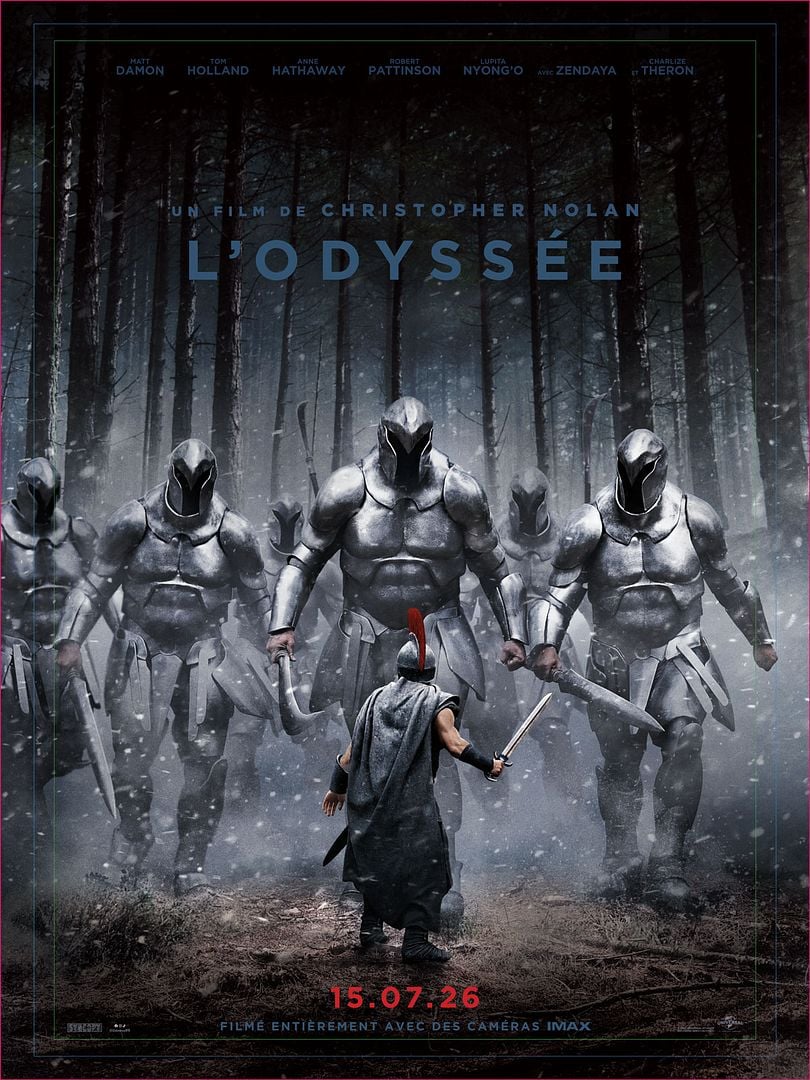
It is a reflection on time, identity, loyalty, cunning, memory, the longing to return, and the difficulty of becoming once again the person one was before setting out.
Why do great journeys always make for great films? Because they provide cinema with a clear and powerful structure. A starting point. A goal. Obstacles.
Landscapes. Encounters. Losses. Transformations. A journey allows us to depict an inner transformation through a physical journey. We see the character moving forward, but above all we realise that they are changing.
For those working in 3D animation and visual effects, this type of narrative also offers exceptional scope. Grand journeys require the creation of worlds, the rendering of extreme environments in a believable way, and the depiction of water, light, storms, creatures, crowds, ships, cities, ruins, gods and monsters. They require a delicate balance between storytelling, art direction, modelling, animation, simulation, lighting, rendering and compositing.
This is precisely where film intersects with the skills developed in a course in 3D animation and special effects: transforming an imaginary world into a visual, comprehensible and credible experience.
The Odyssey, or the story of an impossible return
Before it is a highly anticipated film, *The Odyssey* is first and foremost one of the great founding narratives of our collective imagination. Attributed to Homer, the epic recounts the return of Odysseus, King of Ithaca, following the Trojan War. But this return, which should have been a simple journey, turns into a ten-year odyssey.
Ulysses longs to return to his island, his wife Penelope and his son Telemachus. But the gods, monsters and the vagaries of the sea constantly delay his return. He faces the Cyclops Polyphemus, escapes the Sirens, navigates Circe’s traps, meets Calypso, descends into the underworld, and braves storms and Poseidon’s wrath. At every stage, he gains something and loses something else.
What makes the story so fascinating is that Odysseus is not a hero defined solely by his strength. He is, first and foremost, a man of cunning. He survives because he observes, lies, improvises, negotiates, conceals and invents. When faced with the Cyclops, he does not triumph through brute force, but through intelligence. He gives a false name.
He renders himself invisible through language before making his escape through strategy. He is one of the great screenwriting characters: a hero who acts as much through his words as through his actions.
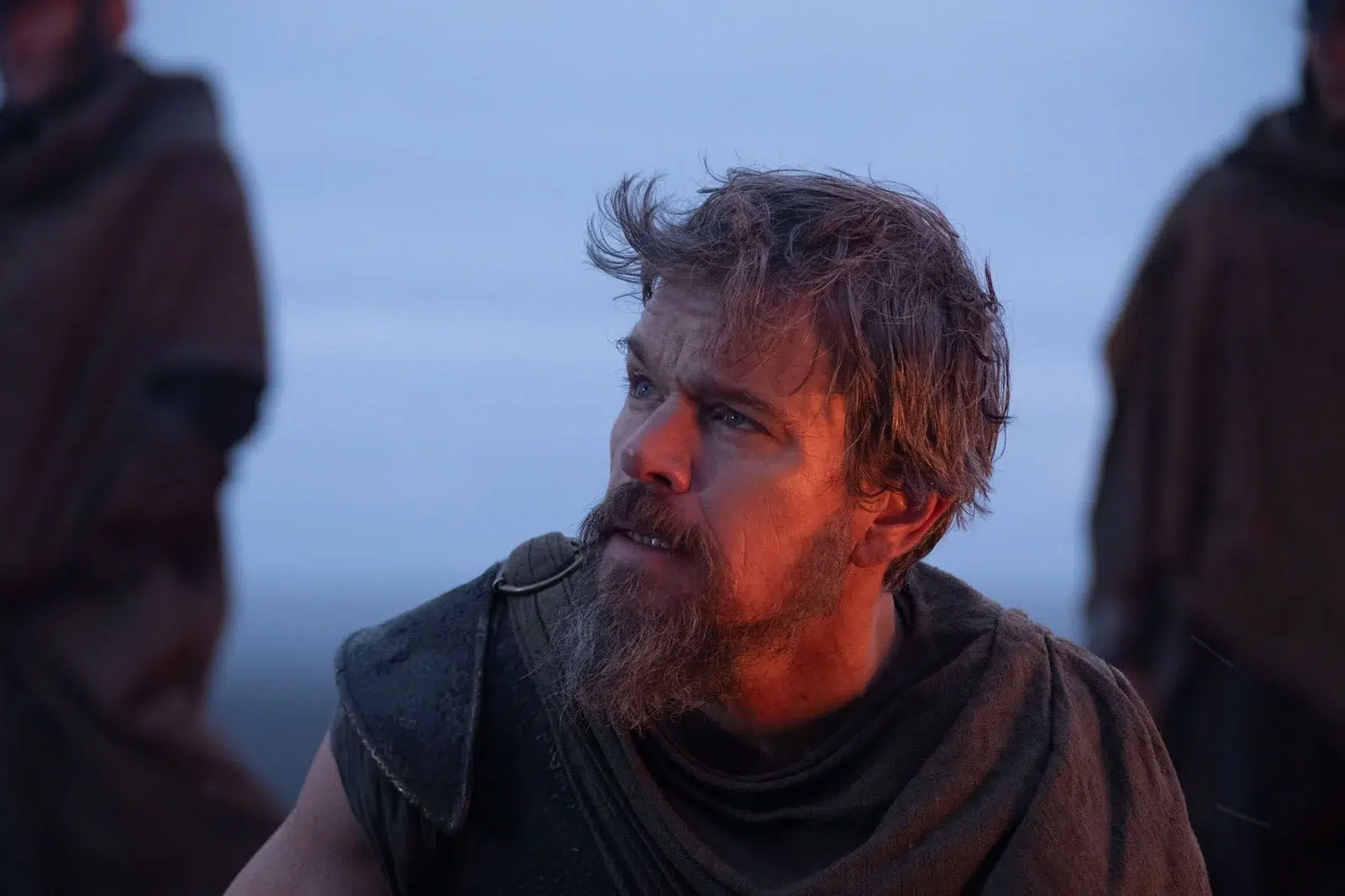
The Odyssey is also a story about absence. Whilst Odysseus wanders, Ithaca falls into disarray. Penelope waits, but her waiting is anything but passive. She resists the suitors who seek to take the place of the missing king. Telemachus, for his part, grows up with a father who has become almost legendary. Odysseus’s return is therefore not merely a geographical victory. He must reclaim his place in a world that has carried on without him.
This is where the story takes on a profoundly cinematic quality. Every external ordeal reflects an inner tension. The ocean, the monsters and the gods give tangible form to a more difficult question: after the war, after exile, after loss, can one truly return home?
Why great stories attract great filmmakers
A great director does not simply choose a story for what it tells. He chooses it for what it allows him to bring to life on screen.
The Odyssey offers a rare combination: a popular narrative structure, symbolic depth and immediate visual power. It is an adventure film, a seafaring film, a war film, a family drama, a mythological tale and an introspective film. All of these elements are contained within the same work.
For a filmmaker like Christopher Nolan, this choice seems logical. His films have often centred on characters confronted by structures that are beyond their control: time in *Interstellar* and *Tenet*, memory in *Memento*, war in *Dunkirk*, and scientific and moral responsibility in *Oppenheimer*. With *The Odyssey*, he tackles an even older concept: that of the journey as the ultimate ordeal.
Adapting a masterpiece requires a certain kind of artistic courage. It is not enough simply to respect the work; one must also breathe new life into it. A text such as *The Odyssey* has stood the test of time because it can be reread, reinterpreted and brought to life on screen. Every era finds its own preoccupations reflected in it. Our own era may see in it the trauma of homecoming, the leader’s loneliness, the hero’s exhaustion, the violence of the world, but also the very human need to find a place, a face, a home.
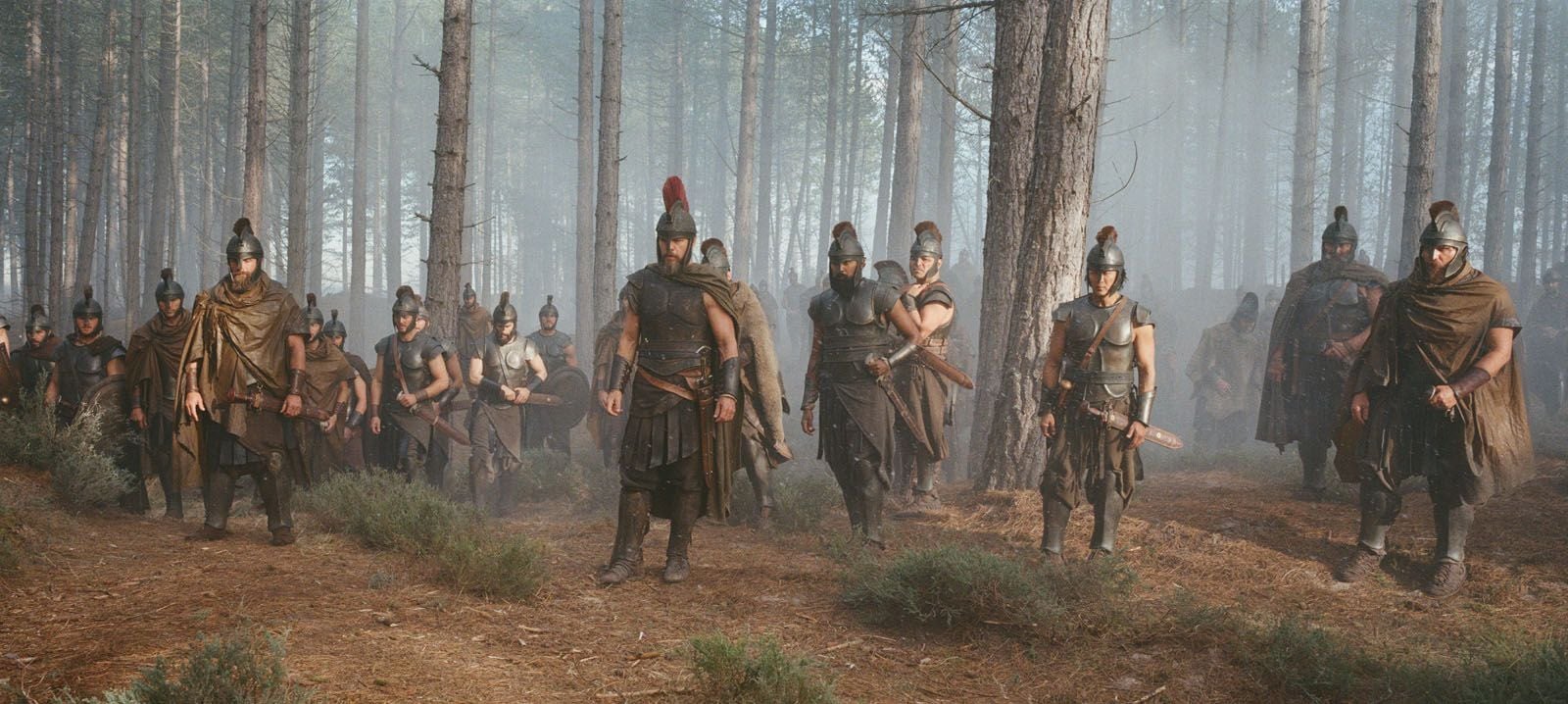
It is this depth that distinguishes a great narrative from a mere spectacular pretext. An epic allows for a grand scale, but it does not rely solely on that. It holds together because it weaves together the intimate and the immense. A man lost at sea. Divine forces surrounding him. A family waiting for him. A kingdom on the brink of collapse. An identity to be reclaimed.
For cinema, it is an ideal subject. For visual artists, it is a considerable challenge.
The journey: a perfect framework for cinema
Cinema loves journeys. It loves departures, passages, thresholds, maps, horizons and obstacles. A journey immediately provides the viewer with a clear path. We know where the character wants to go. We understand what is standing in their way. We can gauge each stage.
In great travel films, geographical progression becomes dramatic progression. *The Lord of the Rings* is not merely the story of a journey towards Mordor. It tells of a character’s slow corruption by the object he carries. *Mad Max: Fury Road* is not merely the story of a flight through the desert. It transforms the road into a space of survival, rage and liberation. *Life of Pi* is not just the story of a teenager adrift at sea. It explores belief, narrative and the way in which we make sense of the unacceptable.
The Odyssey belongs to this genre of storytelling. Its aim is simple: to return to Ithaca. But it is this simplicity that makes the story all the more powerful. The audience does not need to understand a complex plot to follow the story. They can focus on the trials, the emotions, the landscapes and the choices.
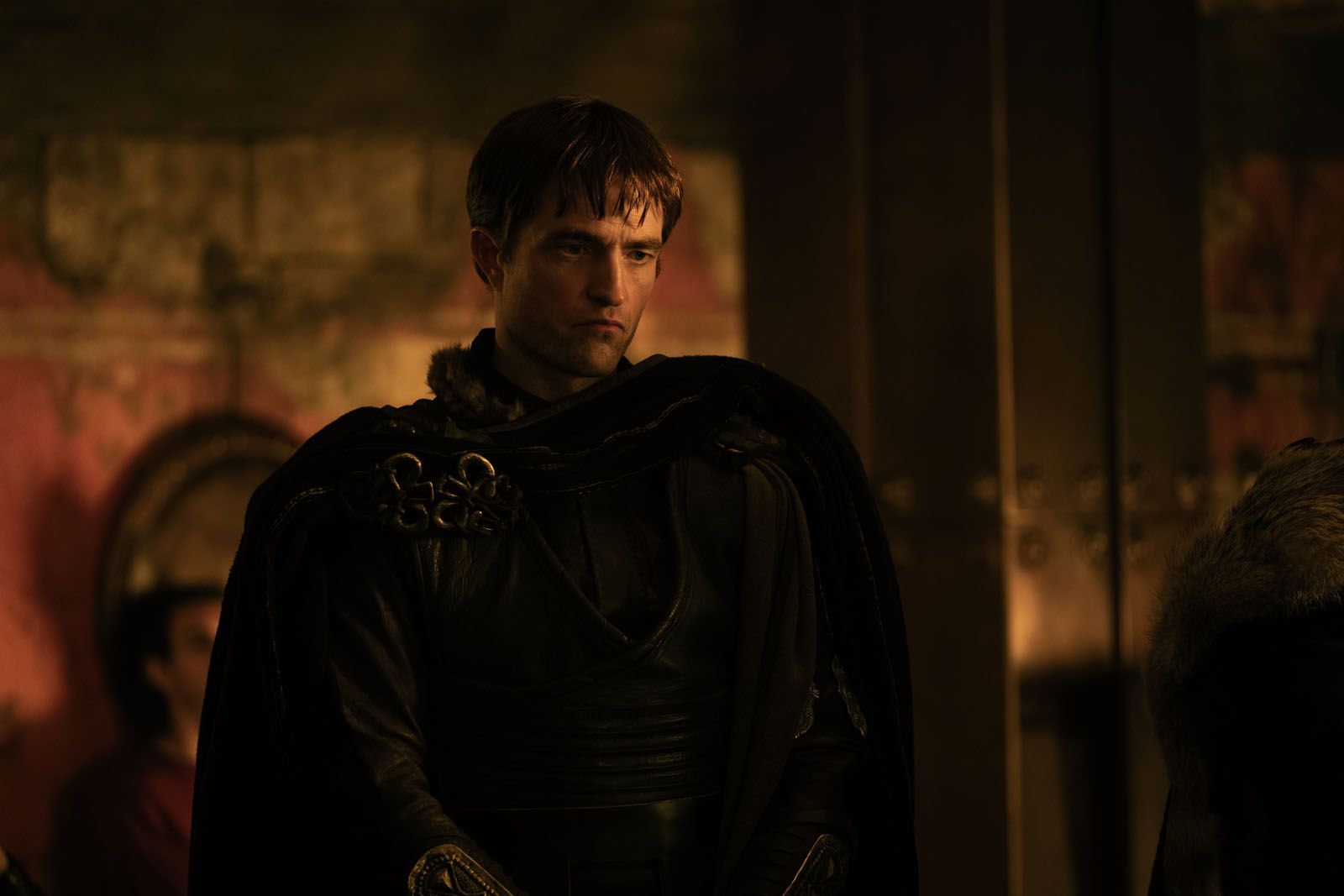
Journeys also make time visible. Bodies grow weary. Clothes wear out. Ships develop cracks. Faces change. The light is no longer the same. The space they travel through leaves its mark on the characters. This is a very powerful directorial principle: the setting is not merely external to the narrative; it leaves its mark on the characters.
For the creative teams, this approach demands a high degree of rigour. They must ensure consistency in the costumes, props, injuries, sets, weather and lighting. A journey is a progression, and this progression must be evident in every detail.
When the setting becomes a character
In a travel film, the setting is never neutral. It does not merely serve to situate the action. It acts. It resists. It threatens. It entices. It misleads.
In *The Odyssey*, the sea is almost a character in its own right. It separates Odysseus from Ithaca. It opens up the way just as much as it blocks it. It can be calm, treacherous, violent, infinite. It becomes the physical embodiment of divine wrath and the uncertainty of the return journey.
The importance of setting is fundamental in cinema. A vast landscape can convey what dialogue would struggle to explain. A tiny ship in a wide shot immediately conveys a sense of loneliness. A huge cave hints at danger even before the monster appears. An island that is too quiet can become unsettling simply through its composition.
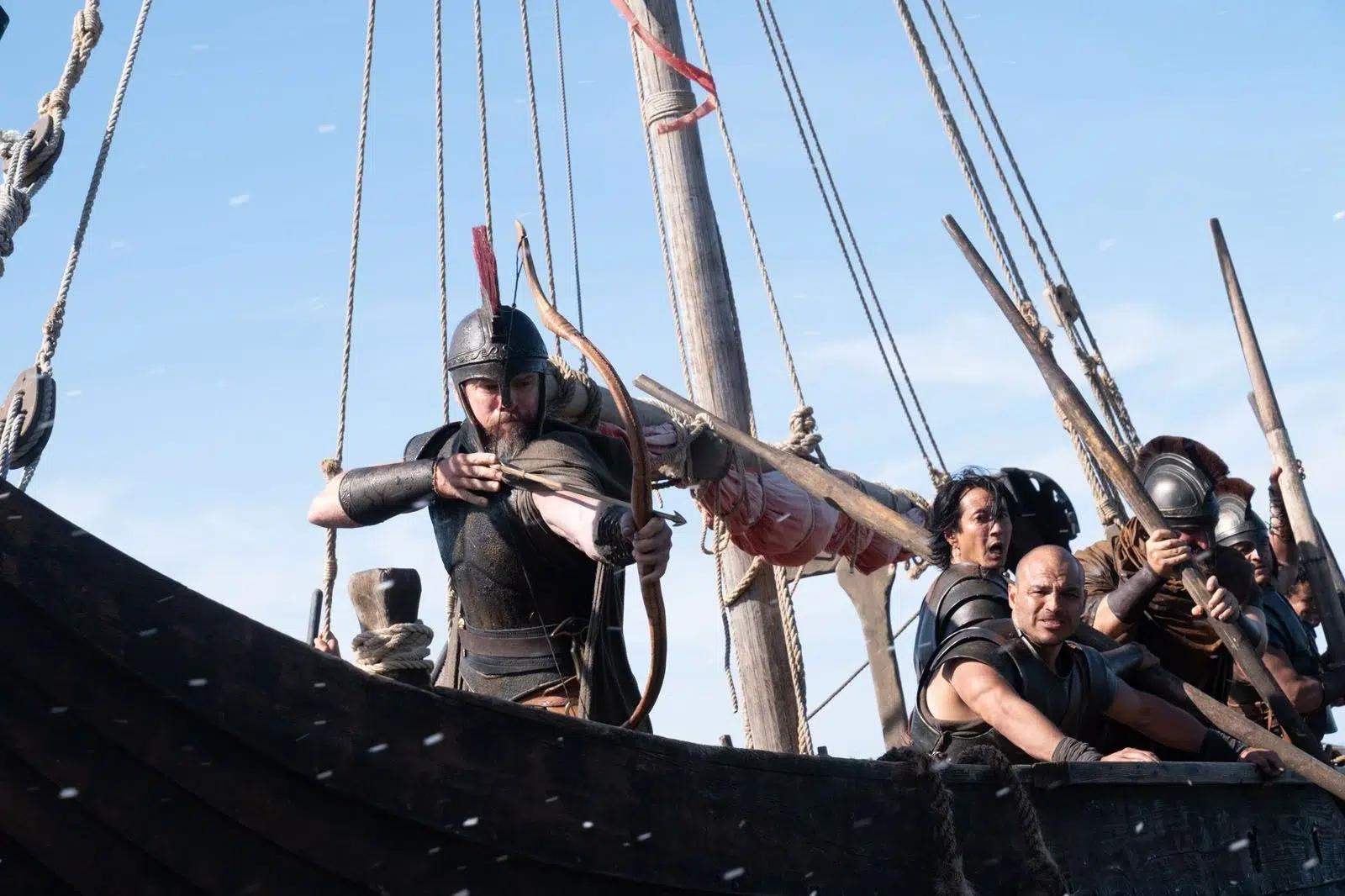
This is where 3D and VFX play a vital role. Creating an environment is not just about producing a beautiful image. It involves designing a space that tells a story. A coastline, a sea, a palace, a cave or a city must have a clear visual identity. They must convey information to the viewer about the world, the era, the danger or the character’s inner state.
Set extensions are used to enlarge a real set. Matte painting can extend a horizon or transform a building. The layout organises the relationship between the camera, the characters and the space. Lighting creates a mood. Compositing brings the elements together so that everything appears to belong to the same shot.
In a story such as *The Odyssey*, the challenge lies in reconciling the real with the mythological. The world must be concrete enough for the audience to believe in it, yet powerful enough to accommodate impossible figures.
The Odyssey and the challenge of augmented reality
Christopher Nolan is often associated with a pursuit of physicality. His films place great emphasis on physical sets, practical effects, the projection format and the cinema experience. *The Odyssey* seems to build on this approach, with a visual ambition designed for the big screen.
But this quest for realism does not diminish the importance of visual effects. In fact, it makes them all the more demanding.
When a film is grounded in a highly physical world, the digital imagery must blend in seamlessly. The viewer sees the real texture of a set, the light on a face, the movement of a camera, the vibrations of a natural environment. Any digital addition, creature or simulation must therefore adhere to this framework.
This is one of the major challenges of contemporary VFX: ensuring the effects remain unseen. The most impressive effects are not always the most visible. A digitally extended sea, an enhanced background, reconstructed architecture, a ship completed in 3D, a multiplied crowd, an intensified storm or a creature integrated into live-action footage can completely transform a shot without the viewer being able to pinpoint exactly how it was created.
Digital technology does not replace direction; it expands upon it. It allows us to show what the camera alone cannot capture, whilst remaining true to the dramatic logic of the shot.
For students of 3D animation and special effects, this is an important lesson. Technique is only valuable if it serves the image. A successful effect is not just a complex one; it is the right one.
The sea, storms and simulation: bringing the wrath of the gods to life
Few things are as difficult to depict as water. It is constantly in motion. It reflects, absorbs and distorts. It reacts to the wind, light, objects and bodies. It can be calm on the surface yet turbulent beneath.
In *The Odyssey*, the sea is not merely a maritime backdrop. It is the arena of trial. It is associated with Poseidon, with loss, with wandering, and with delay. It prevents Odysseus from returning. It forces him to come to terms with the world.
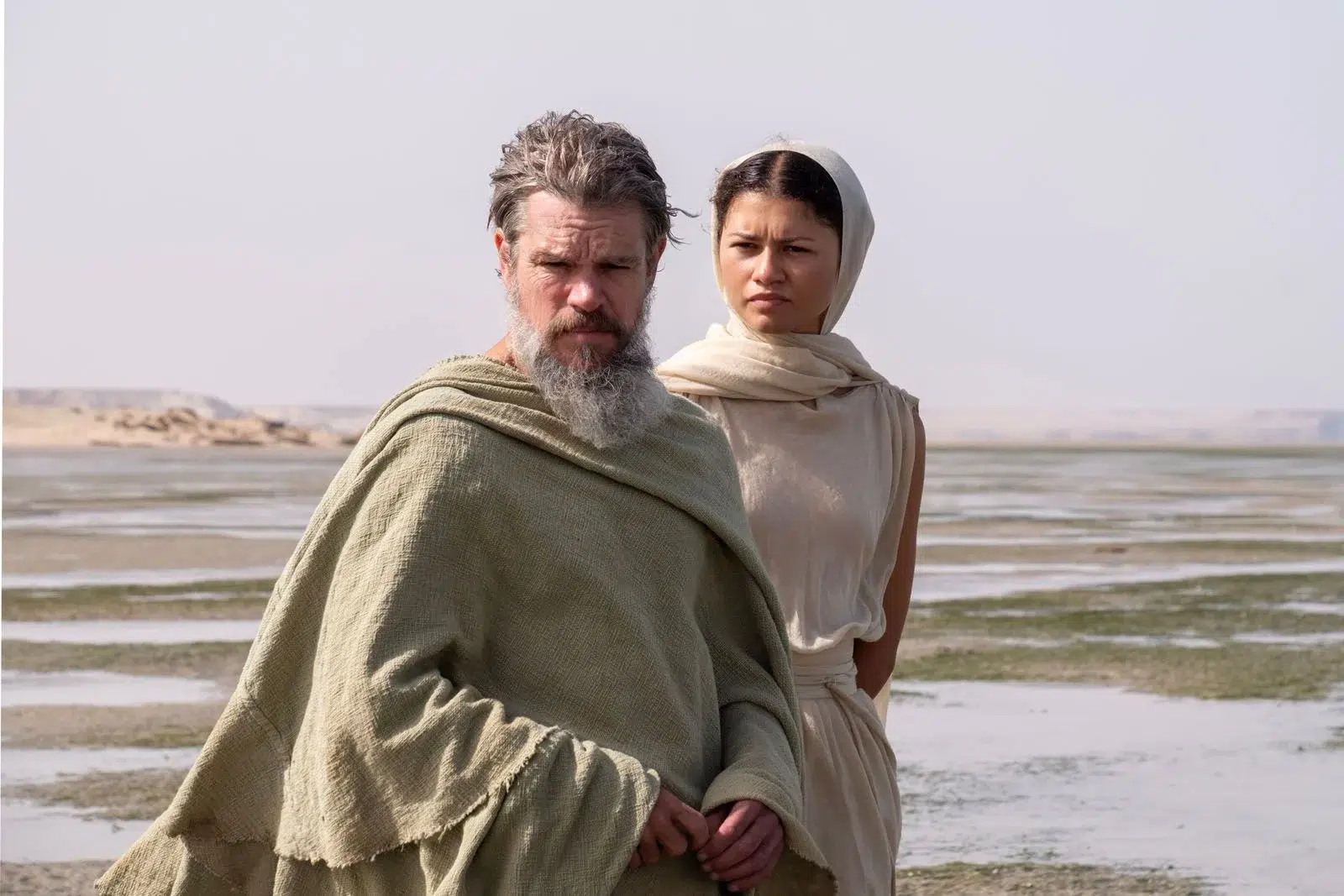
For VFX artists, this type of narrative presents a major challenge. Recreating a believable sea involves working on the waves, the whitewash, the spray, the turbulence, the splashes, the rain, the wind and the interactions with the ships. A storm cannot simply be spectacular; it must be easy to follow. The viewer must understand where the characters are, where the danger is coming from, how the ship is reacting, and what is at risk of failing.
Fluid simulations can be used to generate complex behaviours. But they need to be directed. The size of the waves, the density of the foam, the rhythm of the impacts, the visibility of the boat, and the amount of rain or mist are all artistic choices. Physics provides the foundation. The staging gives it meaning.
This is where VFX work really comes into its own. An FX artist doesn’t simply ‘create water’. They construct a sensation: violence, instability, mass, danger, and sometimes even the sacred.
Creatures, monsters and mythology: giving shape to the impossible
The Odyssey is also a tale of encounters. Odysseus comes across figures who are part of the collective memory: the Cyclops, the Sirens, Circe, Calypso, Charybdis and Scylla. These figures are powerful because they are both ancient and vividly evocative.
For contemporary cinema, this is a tricky question: how can these figures be portrayed without trivialising them? How can a mythological monster be made believable when the audience is already familiar with decades of fantasy films and digital effects?
The answer lies in precision. A successful creature is not defined solely by its design. It must have a logic to it. A recognisable silhouette. A sense of weight. A way of moving. A texture. A sense of life. A credible relationship with light and space.
Creating a 3D creature involves a whole production pipeline. Concept art defines the vision. Modelling builds the shape. Sculpting adds detail. Texturing refines the skin, markings and surface texture. Look development defines how materials react to light. Rigging prepares the creature for animation. Animation brings it to life. CFX can add muscles, tissues and secondary deformations. Lighting and compositing then allow the creature to be integrated into the shot.
Even in a mythological world, the audience needs to believe in the physicality of things. The magical works all the better when it seems to have a physical presence.
The scale, format and experience of the big screen
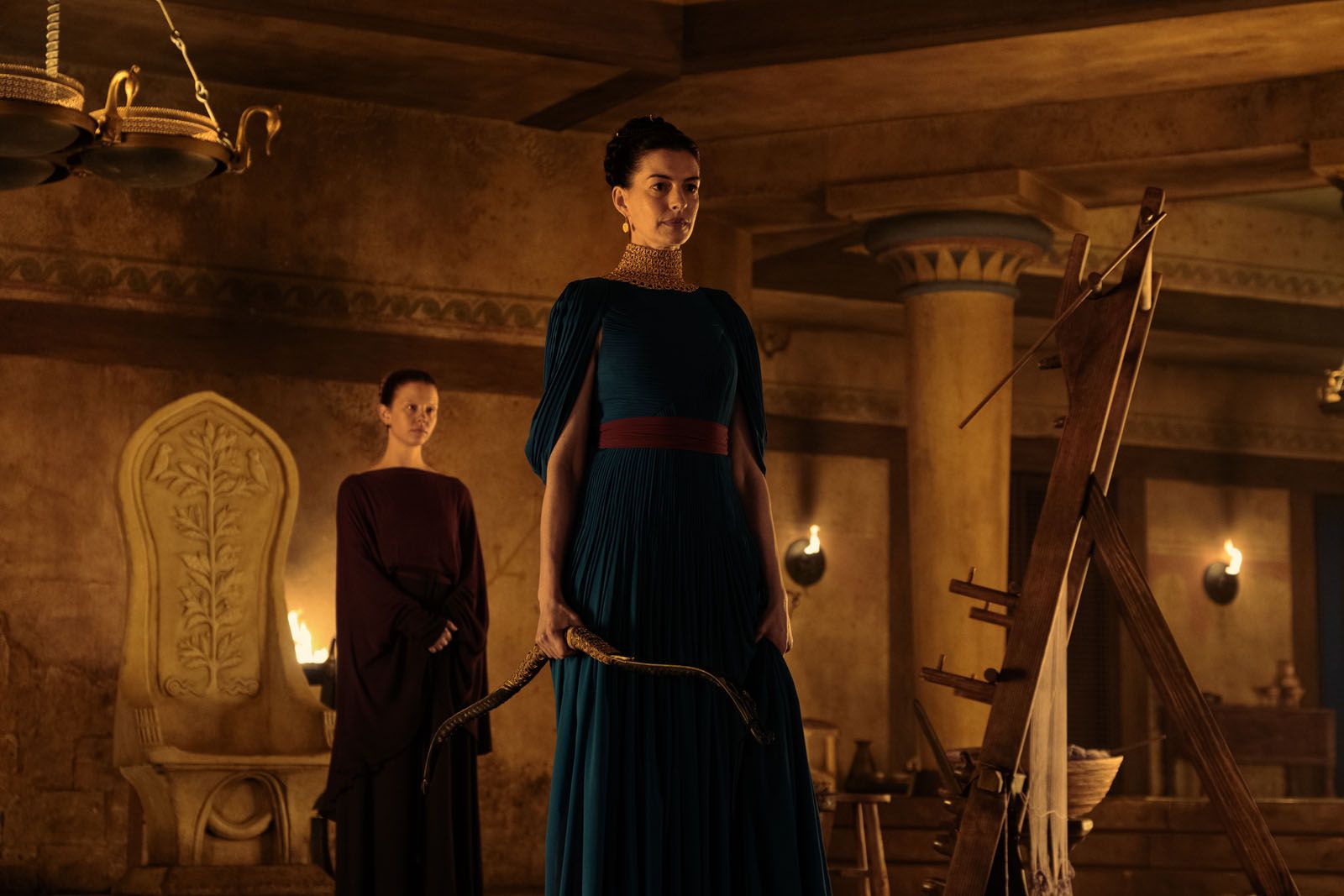
Grand journeys often call for grand imagery. Not simply for the sake of spectacle, but because scale is part of the narrative. A figure facing the ocean, an army before a city, a tiny ship in a storm, an island glimpsed on the horizon: these images are rooted in the relationship between humankind and that which transcends it.
*The Odyssey* is conceived as a cinematic experience. This kind of project serves as a reminder that the creation of an image also depends on its intended use. An image designed for the big screen is not created in the same way as one intended to be viewed casually on a small screen.
Textures must hold up. Environments must be detailed. Renderings must retain their finesse. Composites must stand up to projection. Grain, depth of field, contrasts and light transitions become essential.
For those working in the film industry, this requirement applies to the entire pipeline. Modelling, texturing, shading, lighting, rendering and compositing must all work together. A spectacular shot does not come about solely through a strong idea. It exists because an entire production chain makes it possible to create, optimise and finalise it.
This is an aspect that is often invisible to the public, but central to professionals.
What these films reveal about careers in the visual arts
Great travel films are textbook examples for understanding the fields of 3D animation and visual effects. They bring together almost every conceivable challenge: natural environments, expansive sets, creatures, simulations, crowds, vehicles, atmospheric elements, visual continuity, and the integration of digital imagery into live-action footage.
They also point out that technical roles are deeply intertwined with storytelling. A modeller does not merely create an object; they contribute to the believability of a world. A lighting technician does not simply light a scene; they guide the viewer’s gaze and evoke emotion. An animator does not merely produce movement; they imbue it with intention. A compositor does not simply stitch images together; they craft the final illusion.
That is why a course in 3D animation and special effects cannot be limited to learning how to use software. It must also develop an appreciation of imagery, an understanding of storytelling, and an awareness of framing, composition, pacing and teamwork.
A film like *The Odyssey* serves as a reminder of this obvious fact: visual effects are not simply an afterthought. They are an integral part of the film’s direction. They give the director the means to bring to life worlds that cinema alone could not capture on film.
The journey continues to inspire cinema because it still resonates with us
If great journeys always make for great films, it is because they tell a story that is profoundly human. Setting off, getting lost, wanting to return, no longer recognising the place one left behind, being transformed by the journey: these themes have not lost their relevance.
The Odyssey remains captivating because it does not merely recount the exploits of an ancient hero. It tells of the gap between who we were at the start and who we become along the way. Ulysses wants to return home, but the journey home is not simply a matter of reaching Ithaca. He must reclaim his place, his name and his story.
That is no doubt why this story continues to appeal to filmmakers. It offers spectacle, but it also conveys a more intimate sense of unease. What remains of us after such an ordeal? Can we return without having become someone else? And what is a home worth when the journey has transformed us?
Cinema is the ideal art form for asking these questions, because it can give them a tangible form. A sea. A face. A storm. A silence. An island in the distance.
Today, 3D animation and visual effects build on this power. They do not replace great stories; rather, they provide them with new ways of coming to life on screen.
For aspiring film professionals, *L’Odyssée* reminds us of one essential point: technique is never an end in itself. It becomes powerful when it serves a vision. And great journeys – from Homer to contemporary cinema – remain among the finest ways to learn how to shape that vision.
To see the first images from the film, watch the official French-language trailer for *The Odyssey*, released by Universal Pictures France: