
As the robot employee of this temple of fun, you play StackHead, a maintenance worker who, tired of the monotony of his job, decides to explore the attractions himself.
An adventure that pits you against an army of AI-controlled robots, in a platform game that’s as enjoyable as it is addictive.
For this project, eleven students from ESMA Montpellier, Max-Emilien Allègre (3D, Texture), Arthur Bataille (3D), Aurélie Bellande (3D, Concept Art, Animation), Emanuele Cirronis (Dev, UI Dev), Marion Donadille (3D, Technical Artist, VFX), Sacha Hirsch (Rig), Lauriane Jauze (Lighting, Narrative Design, Level Design, Level Artist), Benjamin Lafage (3D Artist, Concept Art, Level Artist), Matias Lavoye-Sol (Dev), Jules Morquin (VFX) and Mickaël Roussin (Game Design, UI Artist, Concept Art, Animation & Sound), were asked to build a game designed directly for the Switch, Nintendo’s best-selling console of all time.
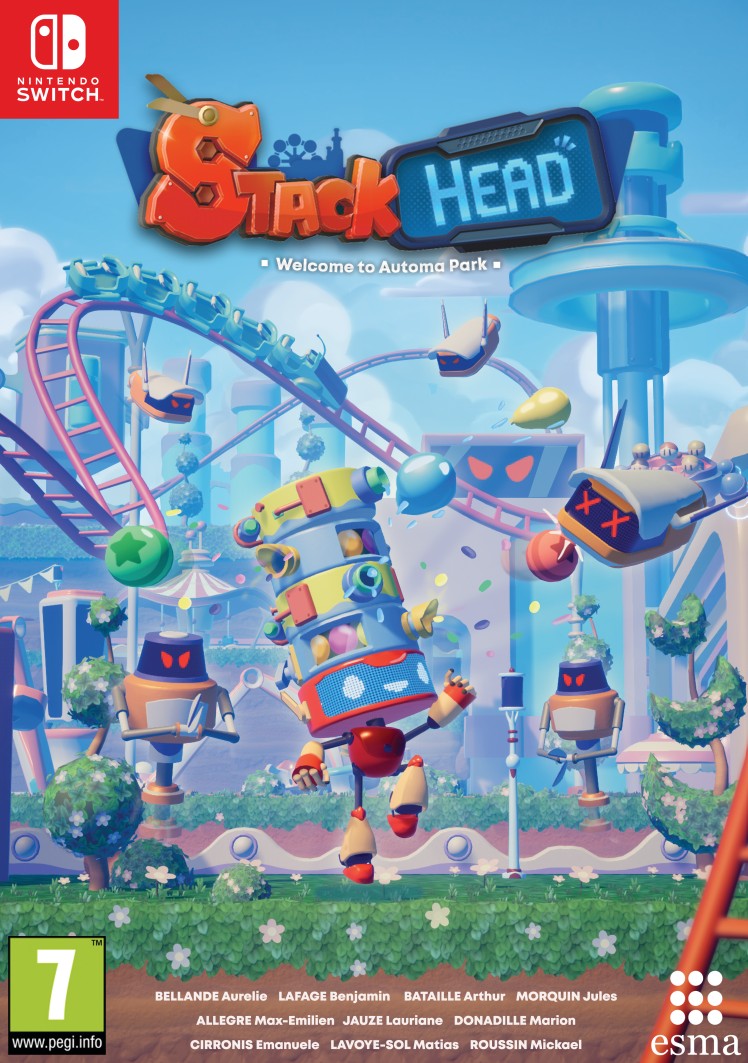
A technical challenge brilliantly met by this talented team in just nine months. And a project that was awarded the prize for Best Technical Achievement at ESMA Video Games 2025, a jury made up of professionals from all over the world. To find out more about how these students managed to bring this project to fruition, we invite you to go behind the scenes of this production.
A cross between platformer and 2.5D shooter
But how does Stackhead work? Available free on itch.io (like all ESMA games), the game mixes platforming and shooting in a dynamic gameplay, where you play as a revolutionary little robot, Stackhead. By stacking various and sundry machines on your head, you’ll become a veritable tower of festive weapons and fight against the established order until you become the next mascot of this amusement park that’s decidedly too dull and monotonous for your taste.
A game that makes fine use of 2.5D to add depth and graphic quality to its environment, while relying on frenetic, accomplished gameplay. (For those in the know, 2.5D allows you to simulate a 3D environment while working in 2D. This format is often used in modern platform games, combining lightness and manoeuvrability with high-quality graphics).
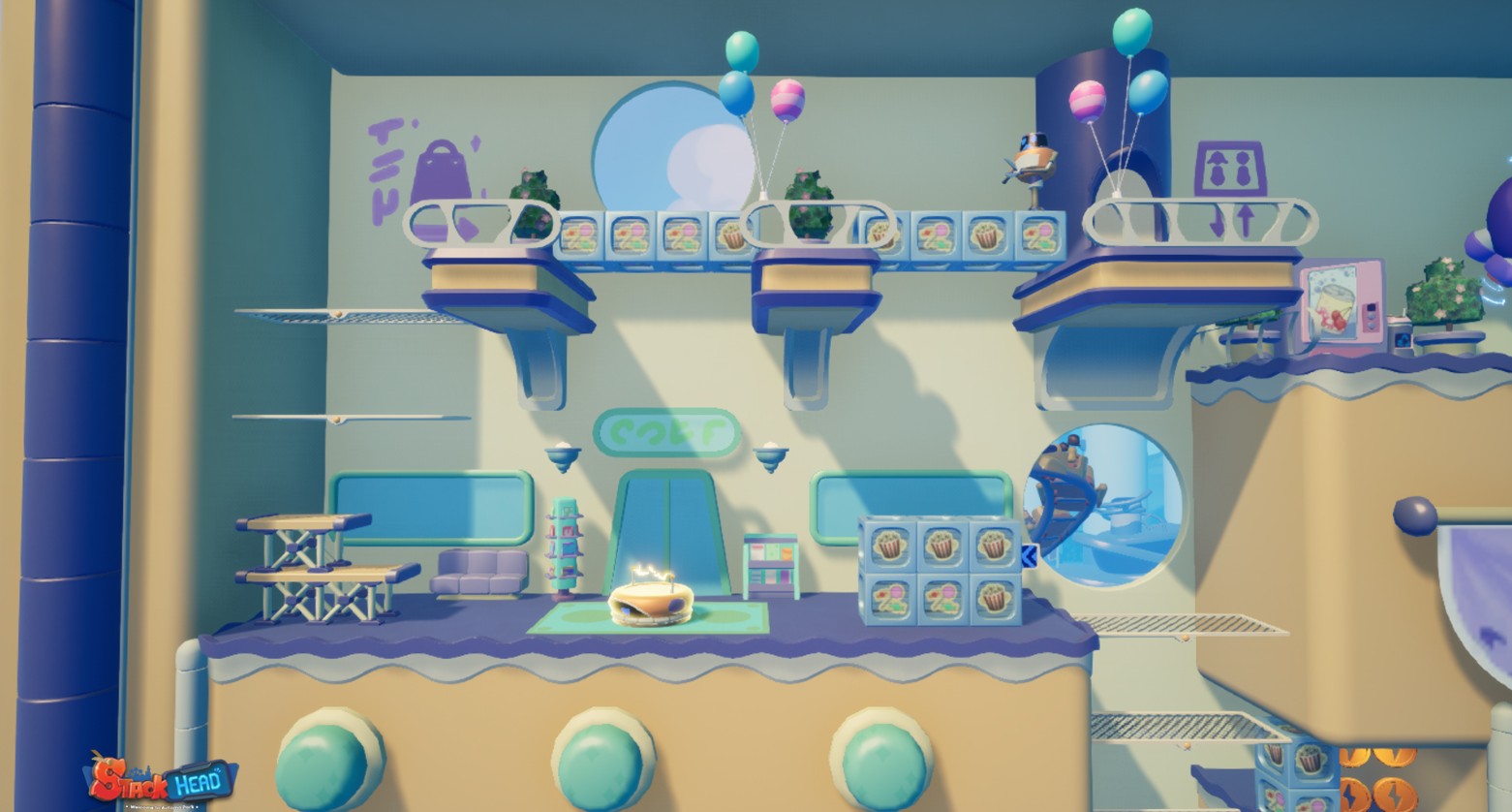
“We’ve chosen to combine adventure and shooting through our character’s two modes: combat and platforming”, explains the team. “The player can switch freely between these two game modes very quickly (around 0.1s), and make the most of stacking. This is the game’s main mechanic, and our ‘key selling point’ for creating a game with a fun, no-holds-barred atmosphere, in the vein of games like Kirby or Mario.”
To the point of losing your mind
By switching from platform mode to combat mode, the hero deploys a whole series of heads (collected over the course of the adventure), each with its own specific power. It’s a zany but highly effective arsenal for fighting the many enemies devised by the team, as well as a whole series of technical challenges to overcome in order to make the mechanics flow smoothly.
The stack of heads (with no height limit, unless it hits an unbreakable ceiling) can also collide with enemies and cause them damage, or destroy breakable blocks or rising platforms.
At the touch of a button, the player can switch back to platform mode to dodge or move through the levels more easily, with ‘combat’ mode making the character heavier and slower.
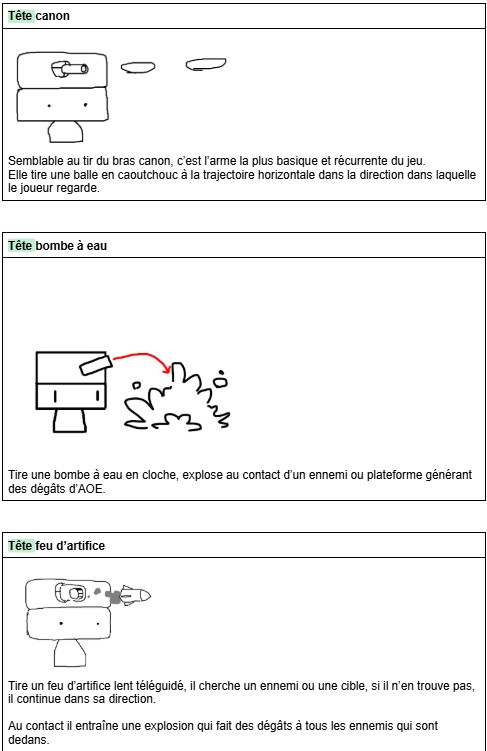
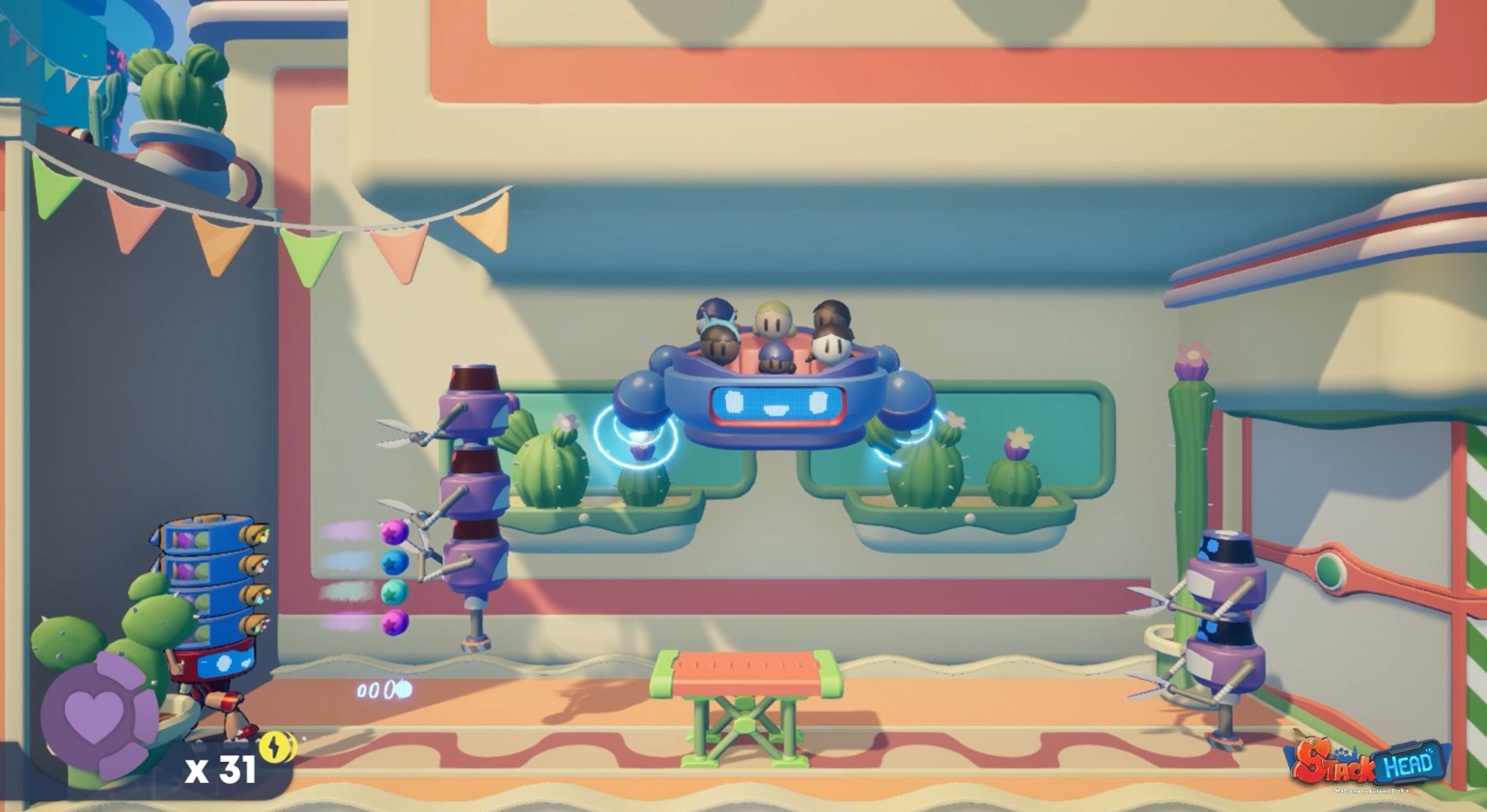
The heads, obtained by destroying ‘headers’ (enemies whose heads the hero recovers and thus benefits from these powers), each have a specific power: the cannon head duplicates the main attack of our hero and his cannon arm; the water bomb head inflicts significant area damage; and finally, the firework head fires a remote-controlled missile that explodes on contact, and also inflicts damage on enemies caught in the blast zone.
(Note that the team had also imagined a fourth ‘yo-yo’ head, which would rotate around the hero’s head and inflict damage on contact, but this was abandoned).
Well thought-out levels
“We’ve built each level around a series of micro-objectives,” explains the team. “Each level introduces one or more new game mechanics and to do this they are divided into three sections: An introduction to present the level’s new mechanic in a simple and safe way. This mechanic is then ‘learned’ in the level, so that the player is encouraged to use it and combine it with the mechanics learned previously, in platforming and combat phases. Finally, the player’s mastery of the mechanics is put to the test in an intense final platform sequence involving combat or an arena battle. If a mechanic is not used in any other level, it must be exploited in a more complex way at this stage.”
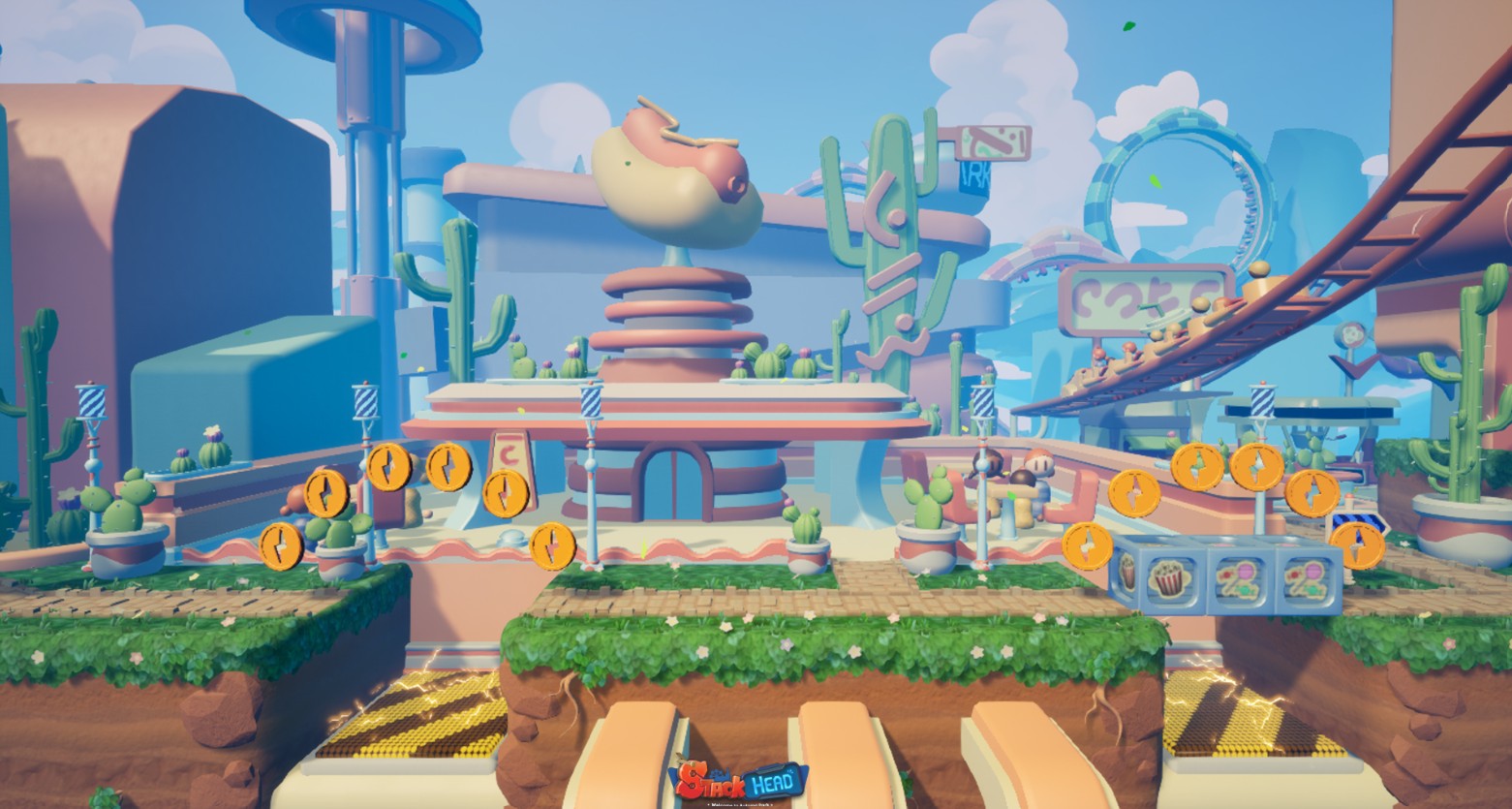
The game, which lasts 30-35 minutes, is divided into four levels and two main zones. The heart of the park, the main zone of the game, is an environment animated by a multitude of varied attractions, vibrant with colour, in perpetual motion and always crowded with visitors. “A place that is both joyful and exhilarating, in which the player is accompanied by an audience presented in the background and which reacts to the player’s successes or failures”, adds the team.
It’s also in this park that the various platforming mechanics will be exploited to the full, as players will have to navigate a Ferris wheel, a Tower of Terror and a maze of ascending platforms where they will have to compete with each other to reach the final boss. It’s an arena battle with high stakes and increasing difficulty, but a challenge that even the most dedicated players won’t shy away from.
A challenge brilliantly met
Designing a video game from start to finish is no mean feat, especially when it’s a student project. But thanks to their team spirit, rigour and stamina, the eleven students who contributed to Stackhead can be proud of their achievement.
A game that marks the culmination of a high-quality training programme combining advanced learning of videogame design tools, the development of artistic creativity and the elaboration of collaborative game design, and which has already won over a wide range of professionals and gamers.
Find out more about the Stackhead game, available here :