
Romain Thouy’s career path does not follow the linear trajectory often associated with careers in the video game industry. Before joining the industry, he worked in a number of different fields: research, software development, IT services, project management, and then production. Now an R&D Product Manager at Virtuos, he takes a clear-eyed yet committed view of a demanding sector, one that has been weakened by recent economic pressures but remains driven by a strong capacity for innovation.
“I’ve had a very varied career path,” he sums up. After completing a PhD in theoretical physics, he began his career in the software industry, initially as a developer at a start-up, working mainly on databases. He then moved into application development, before joining Capgemini, where he spent several years providing technical services. Like many consultants, he eventually moved to one of his clients: AMUE, an organisation that develops software for universities, research institutions, laboratories, the CNRS and Inserm.

This period lasted fourteen years. During this time, he worked on large-scale projects relating to information systems in higher education and research, and gradually moved into project management. But at the same time, he harboured another ambition: to join the video game industry, a sector that had long appealed to him but into which he had not yet found a way to break into.
Getting into video games through social interaction
The turning point came during a skills assessment. Romain then realised that change could no longer remain an abstract idea. At that point, he did not yet know how to make this transition, but he knew it had become necessary.
At first, he followed the traditional route: applying for jobs, sending out CVs and responding to job adverts. But he soon came up against the reality that this sector is difficult to break into for people from outside the industry. He therefore decided to change his approach.
Rather than asking directly for a place, he seeks to create the right conditions for the meeting to take place.
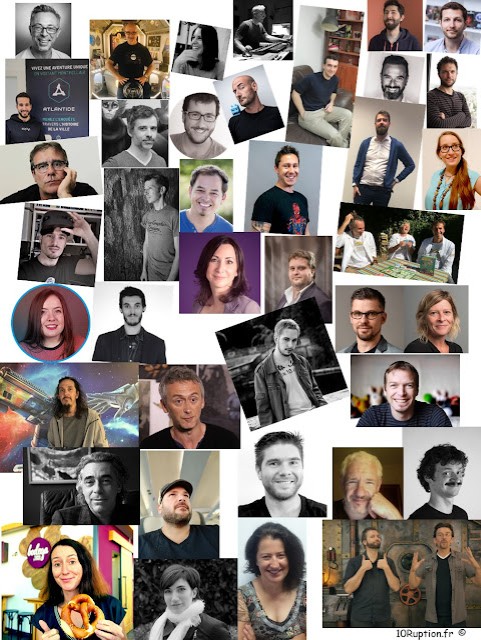
In his spare time, he began conducting interviews with professionals from the video game and animated film industries, focusing on their career paths and how they approach innovation within their studios. In total, he conducted around fifty interviews with studios, professionals and educational institutions, including ESMA. He wrote the articles, had them proofread, and then published them on his blog, 10ruption.fr.
This initiative, which has been running for almost two years, has enabled him to raise his profile in a different way, by entering the sector through genuine dialogue, active listening and the highlighting of people’s career paths. It has also become a means of gaining a better understanding of the norms of a professional environment that he is discovering from the inside, one meeting at a time.
At every interview, Romain briefly presents his own project. He talks about his background, his desire to work in the video game industry, and his interest in studios and their approaches to managing innovation. The approach is based on a simple principle: he raises the profile of the professionals he meets, whilst gradually building up his network. These meetings confirm his intuition: he wants to work in this industry.
From Wild Sheep Studio to Virtuos
This strategy eventually paid off, and his employer offered him a year’s unpaid leave to give it a go. A studio where he’d previously interviewed a developer, Fabien Delpiano, posted a vacancy. The person he’d met suggested he apply. He then joined Wild Sheep Studio in Montpellier as an assistant producer, a role closely related to project management. The experience lasted just over two years, working on the game *Wild*. However, the project was halted following the publisher’s decision to cease production, and the studio was forced to downsize its workforce.
He then joined Virtuos, an international group specialising in the co-development of video games, which encompasses the creation of additional content, the development of remasters, as well as art production and game engine engineering. He joined as a producer and was subsequently promoted to lead producer to support the producers at the Montpellier studio. When Virtuos set up a research and development branch within its Game division, he was offered the role of producer for that division. He now holds the position of R&D Product Manager.
His role lies at the intersection of operations, internal communications and strategy. He monitors the teams’ day-to-day work, helps to disseminate R&D findings to staff, and supports the team director in defining the team’s strategy. The aim of R&D is twofold: to improve client productions and to identify technologies capable of making games more high-performing, more efficient to produce or more visually ambitious.
When asked about the project he is most proud of, however, Romain does not mention a game, a technology or a production. He turns to his career change: a path forged without any initial network in the video game industry, without any obvious credentials, but with a clear approach. A way of turning a long-held ambition into a concrete course of action.
A sector under pressure, but still attractive
This experience has also shaped his view of the industry. He sees a sector that is both attractive and vulnerable. Although he now works more on in-house projects, he noticed a certain economic caution whilst he was involved in client projects. “You can sense the reluctance and the recession,” he notes. Contracts are harder to secure, decisions take longer to reach, and there is less willingness to take risks.
He also experienced this fragility first-hand when the Wild project was halted at his former studio and the studio underwent restructuring. For him, this situation forms part of a wider context. Following the Covid period, the sector saw a strong surge in investment, which was at times excessive. Numerous projects were launched, driven by high consumer demand and a sudden surge in investor interest. But this phase was followed by a sharp correction. “An investor expects a return,” he points out. When those returns fail to materialise, funding dries up, with direct consequences for studios and jobs.
According to him, this tension does not call into question the creative vitality of video games. But it serves as a reminder of a fundamental truth: the success of a game remains difficult to predict. “There is no magic formula for a game’s success. ’ The range of games on offer has become vast, players are constantly bombarded with choices, and even professionals can feel overwhelmed by the sheer volume of new releases. Investors, like some of the major players in the market, sometimes seek to identify replicable models. Yet recent examples continue to show the opposite: small teams can achieve major successes, whilst very expensive productions can fail commercially.
For Romain, this uncertainty is part and parcel of the medium itself. “It’s still an art form,” he emphasises. An industrialised art form, of course, shaped by significant economic, technical and commercial constraints. But an art form nonetheless, the reception of which can never be fully anticipated.
French manufacturing still has some real strengths
His outlook on French production remains optimistic, however. He believes that several regions are gradually developing around the cultural and creative industries, with schools, studios, events, organisations and more supportive public policies. Montpellier, he says, is a prime example of this. “A great deal of effort is being made to support us at every level,” he observes. The presence of schools, studios and events, together with the city’s involvement, is helping to create a more robust ecosystem.
In his view, this local organisation can help the sector weather the current difficulties. “I remain optimistic,” he says of French production. It is a cautious optimism, based more on observations from the ground than on theoretical arguments.
What film studios are looking for in young talent
In his current role, Romain is also involved in recruiting staff for his R&D team. His role is clearly defined and focuses mainly on recruiting programmers. “The teams I work with on R&D are extremely specialised,” he explains. Standards are therefore high, but this does not prevent the team from taking on interns and, where circumstances allow, hiring them on a permanent basis afterwards.
Technical skills remain crucial. In this field, a strong command of C++ and knowledge of at least one game engine are essential. But what matters most is practical experience. Academic knowledge alone is not always enough. Candidates must be able to demonstrate what they have achieved, explain their approach, and outline their personal contribution to team projects. “We’re looking for a specific profile, but also a personality. It’s that unique quality that you need to learn to bring out,” he sums up.
The ability to explain one’s work clearly is essential. Recruiters know that a student or recent graduate does not yet have extensive professional experience. They therefore do not expect complete mastery of every subject. Instead, they seek to understand how the candidate thinks, what they have actually achieved, and how they analyse both their successes and their challenges.
Skill, humility and communication
A strong grounding in mathematics is also very important, particularly in linear algebra, when the topics relate to rendering or graphics performance. But technical skills are only part of the picture. rOmain also emphasises interpersonal and professional qualities: curiosity, humility, adaptability and a desire to learn.
Game development is a team effort, which means, amongst other things, maintainingclear, transparent and honest communication.
In the video game industry, projects can change, teams can evolve, and assignments can last anywhere from a few months to several years. You therefore need to be able to adapt to different contexts. You also need to be able to raise the alarm quickly if you encounter a problem. “Being able to say when you’re struggling,” he says, “is an important skill. It allows the producer and the lead to adjust the production schedule and support, to allow extra time where possible, to offer help or to reorganise the task.” “It’s not a failure at all,” he points out. On the contrary, it’s essential for teamwork to function effectively.
For students, preparation therefore involves hands-on experience. Team projects are essential, because video game development is largely a collaborative endeavour. Long-term work placements also allow for greater immersion. At Virtuos, six-month placements are preferred, as they allow time to fully integrate the intern and entrust them with tasks that closely reflect the team’s day-to-day operations.
He also advises recent graduates to take care over how they present their work. There is no point in showing everything. It is better to select a few strong pieces of work, clearly explained, rather than presenting a collection that is too broad and uneven. “It’s not the sheer volume of everything they’ve done that counts,” he points out. “A portfolio that’s too disorganised can have the opposite effect.”
Artificial intelligence as an augmentation tool
When it comes to artificial intelligence, Romain takes a measured approach. He does not intend to offer a sweeping view of the sector’s future, but describes how he uses it himself. In particular, he uses Copilot to find information in conversations, Teams documents or SharePoint. In a profession where information flows constantly, AI is becoming a useful support tool, provided that a rigorous approach to verification is maintained. “It’s the sources that interest me,” he explains. The tool can suggest leads, but reviewing, analysing and formulating the information remains his responsibility.
In his view, artificial intelligence should be seen as a tool for enhancement, rather than a replacement for human judgement. “We must see it as something that enhances our capabilities. ” Otherwise, there is a risk of gradually losing skills through lack of practice. He draws a parallel with spell-checkers, which have already changed our relationship with writing and our attention to linguistic accuracy.
In software development, AI can assist with code reviews, learning a programming language, exploring a library or creating APIs. However, its use must remain strictly regulated, particularly for intellectual property reasons. In a production intended for a client, the content must be created solely by humans.
AI can, however, contribute to the thought process, the structuring of ideas or technical analysis. Within her team, it is implemented as part of an application designed to help programmers optimise the performance of game engines. These tools generate massive volumes of data, and AI can help to analyse, compare and detect anomalies in order to identify performance or memory issues. “It’s a valuable aid for programmers,” he says.
When it comes to the impact of AI on jobs, he remains cautious. He does not claim to have directly observed any jobs disappearing in his own environment. He does, however, note that particular vigilance is required regarding artistic professions, which are often cited as being among the first to be affected. He also observes a certain degree of standardisation in some AI-generated content, particularly images or videos shared online. As they tend to resemble one another, these creations can quickly lose their uniqueness.
Don’t face the sector alone
When speaking to students who want to get into the video game industry, rOmain offers some very practical advice. The first piece of advice is not to isolate yourself. He encourages young people to get involved with local organisations, take part in game jams, meet other professionals and share their work.
He also emphasises mutual support. Sharing feedback from interviews, passing on job offers, discussing opportunities: for him, these actions are not just a matter of solidarity, but a healthy way to enter the professional world. The video game industry functions as a relatively close-knit community, where relationships matter, where recommendations circulate, and where people’s career paths often intersect.
This close proximity also means you need to be mindful of your professional conduct. Whether on an internship or in a company, a reputation is built quickly. He points out that it is common for studios to contact one another to seek feedback on a former intern or candidate. Professionalism, reliability and work ethic can therefore carry just as much weight as the skills you demonstrate.
Lifelines that are not predetermined
Having entered the video game industry relatively late, without a career path initially intended for this sector, rOmain carved out his place through curiosity, perseverance and chance encounters. From this, he has drawn a simple conviction, one that is useful for those who are hesitant to take the plunge into a demanding environment: career paths are not always set in stone.
“A lot of things are possible,” he said. In his case, that possibility did not remain merely theoretical. It was built up patiently, interview by interview, until it became a career.
Acknowledgements:
“As for my career change, don’t think I did it all on my own: without the people I met through my blog, and without Wild Sheep taking a chance on me by hiring me, things could have turned out very differently!
I would like to express my sincere thanks, in the order in which they appear:
- Claire Zamora, the first incredible figure from the gaming world I ever interviewed, back when I was a complete unknown (and very awkward)
- The other 49 fascinating personalities from Occitanie who were interviewed,
- Fabien Delpiano and Laura Fournier for offering me the interview at Wild Sheep Studio
- Céline Tellier, for daring to take me on !
- Steven Ter Heide, for teaching me so much about video games and the role of a producer,
- Florian Golestin, who turned me into a producer,
- Marianne Calva and Alexis Vaisse, who placed their trust in me at Virtuos
“THANK YOU!”